> ## Documentation Index
> Fetch the complete documentation index at: https://docs.ntop.com/llms.txt
> Use this file to discover all available pages before exploring further.
# List Processing and Sequencing
## List Processing
When applicable, blocks can accept list inputs instead of singular inputs. The block will then become a listed block of the same length as the input list. We refer to this as list processing—it can be useful for running through a series of input options, as shown below.
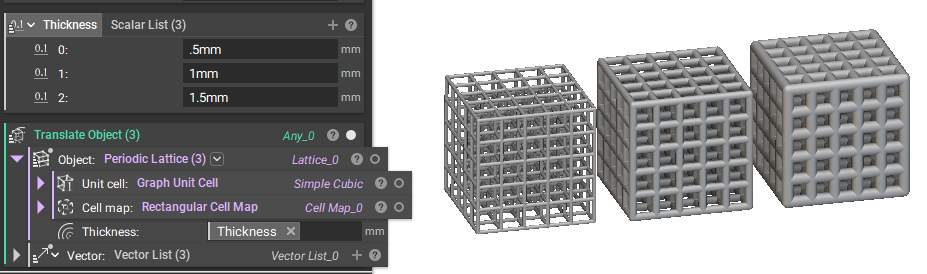 In this example, instead of using three **Periodic Lattice**blocks, we can use just one to create three lattice structures with different beam thicknesses. We can further automate this process using sequencing blocks.
## Sequencing
If you create a scalar list, use one of our three sequencing blocks below. These blocks can be found in the *Math*tab under *Utilities*.
In this example, instead of using three **Periodic Lattice**blocks, we can use just one to create three lattice structures with different beam thicknesses. We can further automate this process using sequencing blocks.
## Sequencing
If you create a scalar list, use one of our three sequencing blocks below. These blocks can be found in the *Math*tab under *Utilities*.
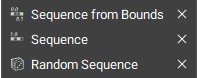 A **Sequence**creates an equally spaced sequence of values.
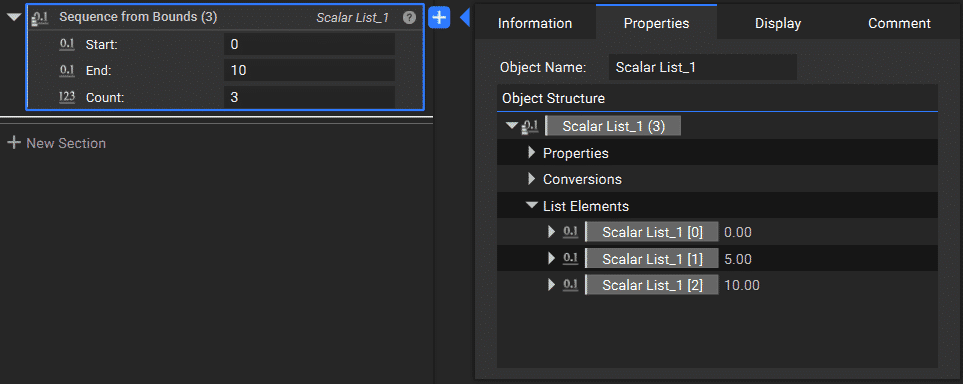
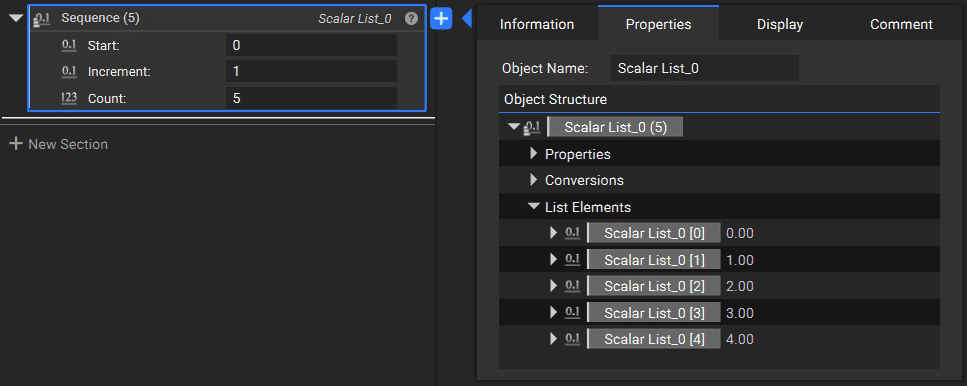 A **Sequence from Bounds**will create an equally spaced sequence between two values.
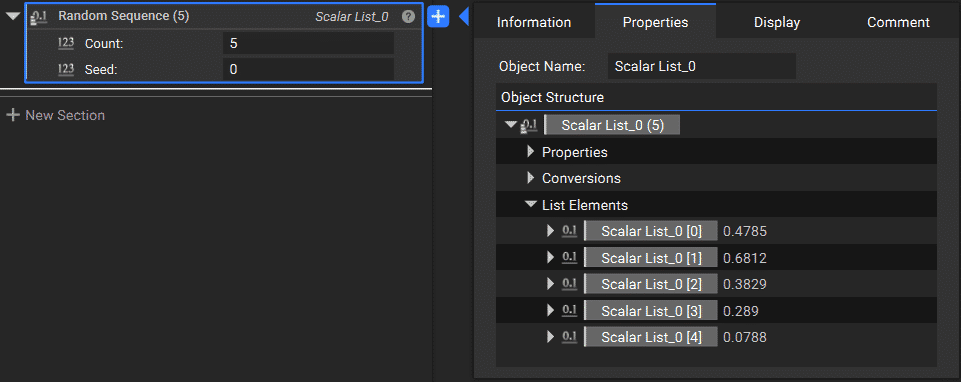
 A **Random Sequence** will create a sequence of random scalar numbers from 0 to 1.