> ## Documentation Index
> Fetch the complete documentation index at: https://docs.ntop.com/llms.txt
> Use this file to discover all available pages before exploring further.
# Boundary Conditions
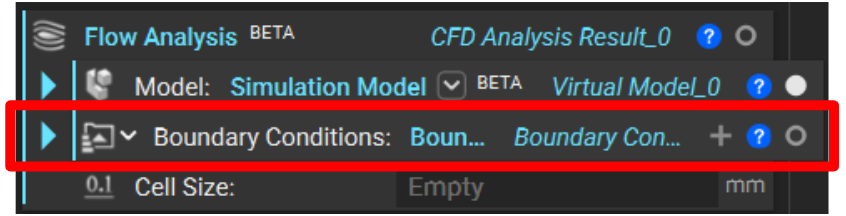
After defining our flow analysis *Model*, we assign conditions at our inlet and outlets using *Boundary Conditions*. The **Flow Analysis** block auto-generates an empty **Boundary Condition List**.
 ## Assign Boundary Conditions
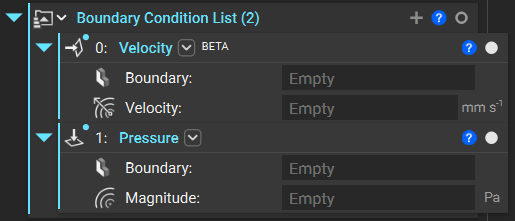
 Within the **Boundary Condition List**, we describe the fluid's velocity.
**Velocity** is a *Boundary Condition* we typically assign at the inlet(s) of the fluid domain.
**Pressure** is a *Boundary Condition* we typically assign at the outlet(s). A good practice is to assign a gauge pressure of 0 to determine pressure differential across your system.
Within the **Boundary Condition List**, we describe the fluid's velocity.
**Velocity** is a *Boundary Condition* we typically assign at the inlet(s) of the fluid domain.
**Pressure** is a *Boundary Condition* we typically assign at the outlet(s). A good practice is to assign a gauge pressure of 0 to determine pressure differential across your system.
 ## Define a Boundary for Each Boundary Condition
 Now, we must define a location at which to apply these boundary conditions. We do these with virtual boundaries.
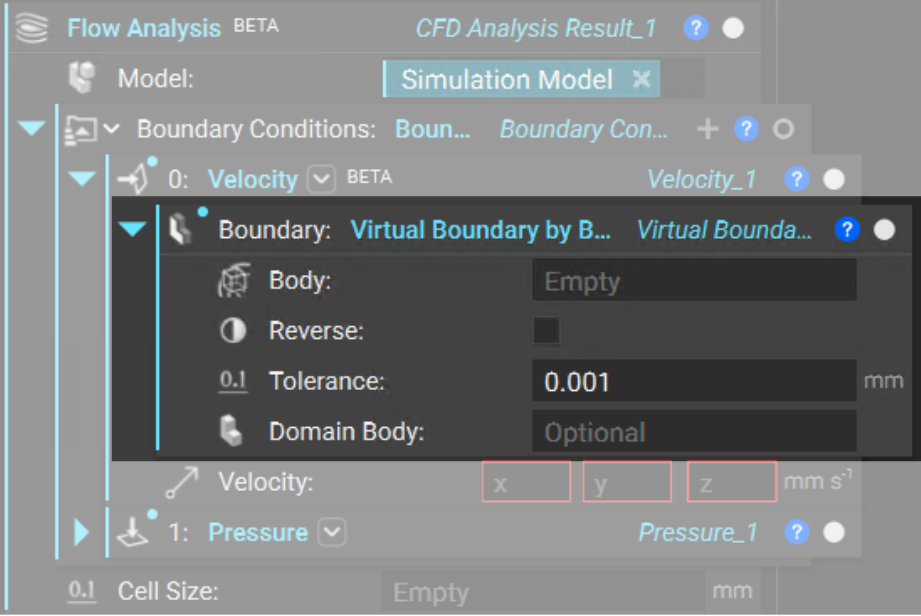
Just as we saw with the *FE Domain* versus the *Virtual Domain* in the [Simulation Model](https://learn.ntop.com/?post_type=sfwd-lessons\&p=13174), the flow analysis uses ***virtual boundaries*** rather than finite element (FE) boundaries. We create these using the **Virtual Boundary by Body** block.
Now, we must define a location at which to apply these boundary conditions. We do these with virtual boundaries.
Just as we saw with the *FE Domain* versus the *Virtual Domain* in the [Simulation Model](https://learn.ntop.com/?post_type=sfwd-lessons\&p=13174), the flow analysis uses ***virtual boundaries*** rather than finite element (FE) boundaries. We create these using the **Virtual Boundary by Body** block.
 As a rule of thumb, we should define the boundary thickness as less than *0.5\*(cell size)*.
**Note**: The boundary of a fluid domain with which is not used to define an pressure/velocity boundary conditions is considered to have a no slip boundary condition. At these boundaries, the fluid velocity is 0.
As a rule of thumb, we should define the boundary thickness as less than *0.5\*(cell size)*.
**Note**: The boundary of a fluid domain with which is not used to define an pressure/velocity boundary conditions is considered to have a no slip boundary condition. At these boundaries, the fluid velocity is 0.