> ## Documentation Index
> Fetch the complete documentation index at: https://docs.ntop.com/llms.txt
> Use this file to discover all available pages before exploring further.
# Delaunay Lattice
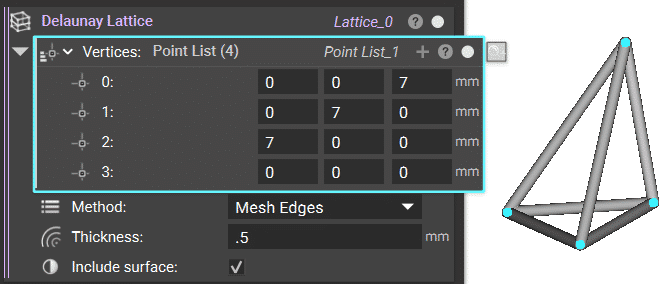
The **Delaunay Lattice** creates a lattice forming a Delaunay tetrahedralization from a list of points, as shown below. The lattice consists of triangles that maximize the minimum angle in each triangle. Tetrahedralization requires at least four points to run.
 Choose from the following lattice creation methods:
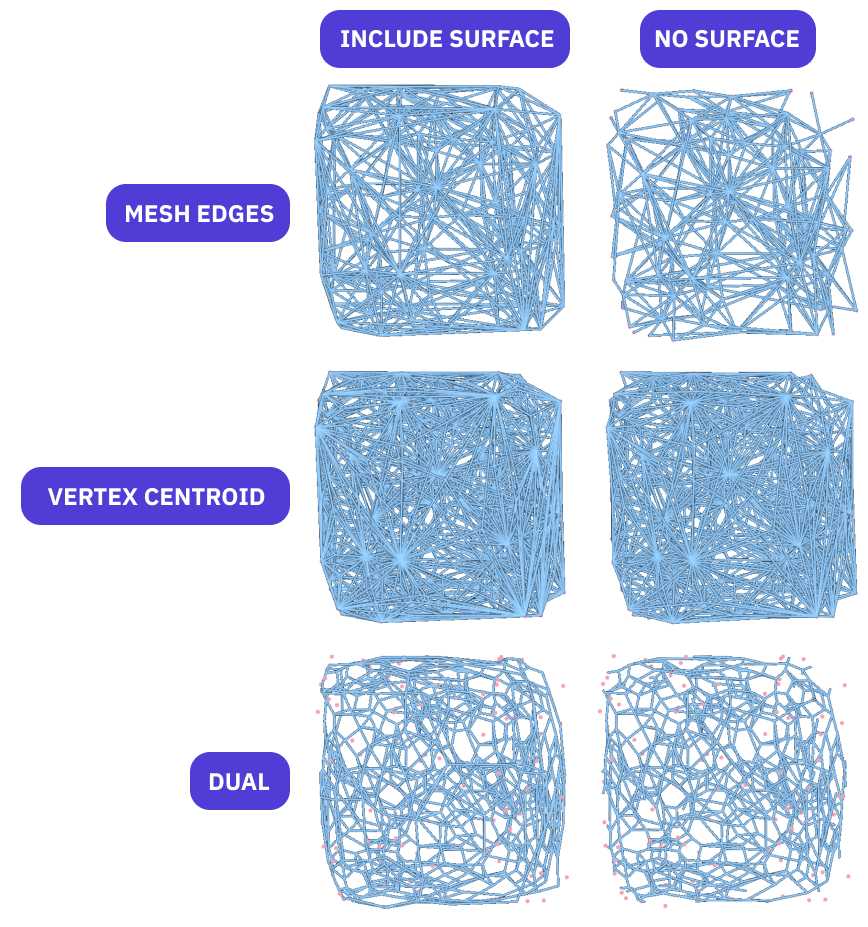
* **Mesh edges:** Creates lattice beams along the mesh edges.
* **Vertex Centroid:** Creates a vertex at each mesh face's centroid and the mesh vertices. Lattice beams connect the vertices.
* **Dual:** Creates a vertex at the centroid of each mesh face and creates a connecting beam to the next closest mesh centroid.
Choose from the following lattice creation methods:
* **Mesh edges:** Creates lattice beams along the mesh edges.
* **Vertex Centroid:** Creates a vertex at each mesh face's centroid and the mesh vertices. Lattice beams connect the vertices.
* **Dual:** Creates a vertex at the centroid of each mesh face and creates a connecting beam to the next closest mesh centroid.
 ## Stochastic Lattice Types
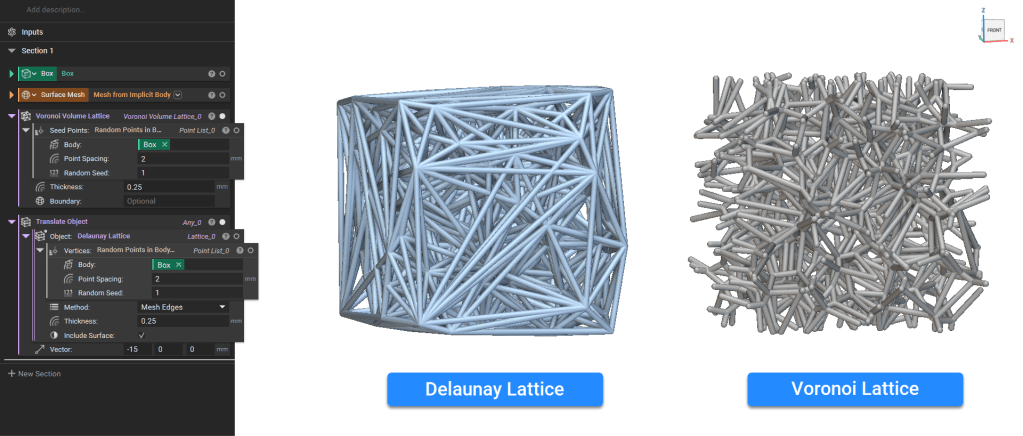
Since maximizing minimum angles prevents long beams, the resulting Delaunay structures are typically stiff. The result is a stochastic, stiff lattice. In contrast, the Voronoi lattice is typically softer/ more flexible.
## Stochastic Lattice Types
Since maximizing minimum angles prevents long beams, the resulting Delaunay structures are typically stiff. The result is a stochastic, stiff lattice. In contrast, the Voronoi lattice is typically softer/ more flexible.