> ## Documentation Index
> Fetch the complete documentation index at: https://docs.ntop.com/llms.txt
> Use this file to discover all available pages before exploring further.
# Meshing in nTop
Meshing is the process of dividing a 3D model into thousands of elements to define its shape — the more detailed the mesh, the better the approximation.
There are three main types of meshes: Mesh (also known as a surface mesh), Tet/Volume Mesh (a solid mesh), and FE Mesh (Used for simulation and is a solid mesh). In this lesson, we will focus on this first type, but later in this course, we will also discuss Volume and FE Meshes.
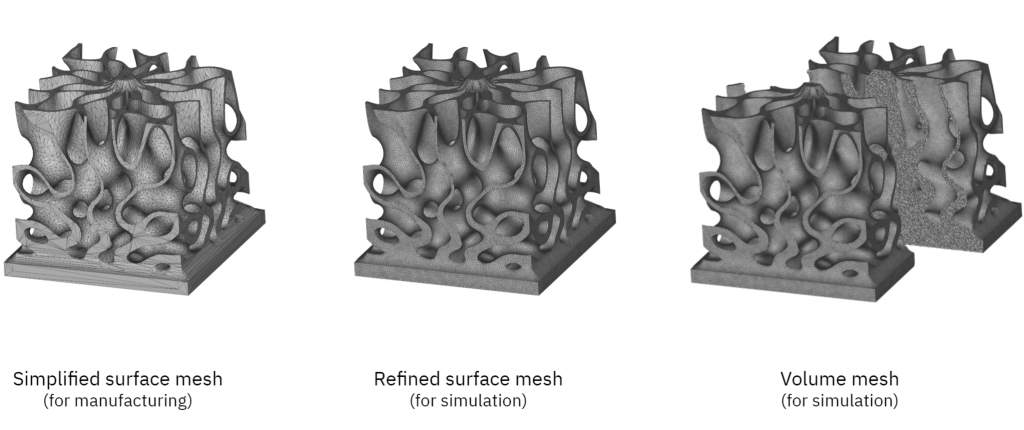 Simplified meshes are suitable for manufacturing, while more refined meshes are more suitable for FEA and CFD and can be converted into volume meshes.
* **Surface meshes** use two-dimensional elements — typically triangles or quads — to approximate the outer surface of a 3D body. You can use surface meshes in manufacturing or rendering applications and CAE simulation.
* **Volume meshes**, also known as solid meshes, use three-dimensional elements — typically tetrahedrons, hexahedrons, and polyhedrons — to define the surface and interior structure. To run FE or CFD simulations, you can convert surface meshes into volume meshes.
## **What is a Surface Mesh?**
A mesh/surface mesh is a discretization of a surface geometry using **vertices**, **edges**, and **faces**. **Mesh Connectivity** defines the incidence relations among mesh elements (adjacent vertices and edges of a face, etc.). **Mesh Geometry** specifies the position and other geometric characteristics of each vertex. Other names for a mesh include surface mesh, surface, and domain.
Simplified meshes are suitable for manufacturing, while more refined meshes are more suitable for FEA and CFD and can be converted into volume meshes.
* **Surface meshes** use two-dimensional elements — typically triangles or quads — to approximate the outer surface of a 3D body. You can use surface meshes in manufacturing or rendering applications and CAE simulation.
* **Volume meshes**, also known as solid meshes, use three-dimensional elements — typically tetrahedrons, hexahedrons, and polyhedrons — to define the surface and interior structure. To run FE or CFD simulations, you can convert surface meshes into volume meshes.
## **What is a Surface Mesh?**
A mesh/surface mesh is a discretization of a surface geometry using **vertices**, **edges**, and **faces**. **Mesh Connectivity** defines the incidence relations among mesh elements (adjacent vertices and edges of a face, etc.). **Mesh Geometry** specifies the position and other geometric characteristics of each vertex. Other names for a mesh include surface mesh, surface, and domain.