> ## Documentation Index
> Fetch the complete documentation index at: https://docs.ntop.com/llms.txt
> Use this file to discover all available pages before exploring further.
# Thermal Material Properties
In this lesson, we will explore material properties and different types of thermal analysis offered in nTop.
## Thermal Analysis
In the **Isotropic / Orthotropic Thermal Property** blocks, we specify values of *Conductivity* *(W/(m⋅K))* and*Specific Heat* *(J/(kg⋅K))*.
 Next, we input the **Isotropic / Orthotropic Thermal Property** into the **Isotropic / Orthotropic Material Property List** block within an **Isotropic / Orthotropic Material** block as shown below.
 ***
## Thermal Stress Analysis
As mentioned before, a *thermal stress analysis* is essentially a static stress analysis which considers the expansion / contraction effects of a thermal load (thermal fields) from a thermal analysis.
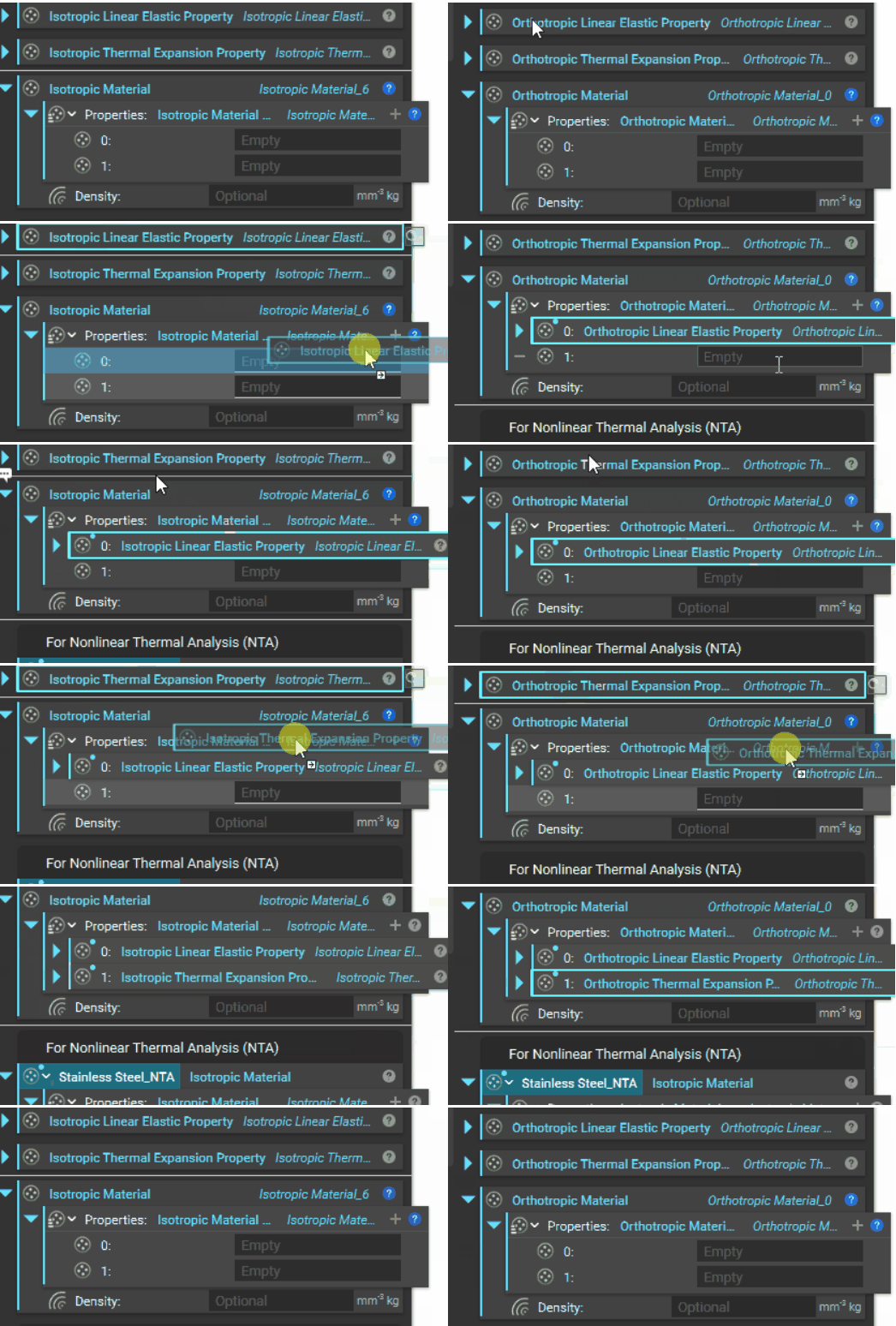
To run a thermal stress analysis, we must define an additional property (i.e. an **Isotropic / Orthotropic Thermal Expansion Property**) with a value of *coefficient of thermal expansion (CTE)* *(K-1)* specified, apart from the usual **Isotropic / Orthotropic Linear Elastic Property** in the **Isotropic / Orthotropic Material** block as shown below.
***
## Thermal Stress Analysis
As mentioned before, a *thermal stress analysis* is essentially a static stress analysis which considers the expansion / contraction effects of a thermal load (thermal fields) from a thermal analysis.
To run a thermal stress analysis, we must define an additional property (i.e. an **Isotropic / Orthotropic Thermal Expansion Property**) with a value of *coefficient of thermal expansion (CTE)* *(K-1)* specified, apart from the usual **Isotropic / Orthotropic Linear Elastic Property** in the **Isotropic / Orthotropic Material** block as shown below.

 ***
## Transient Thermal Analysis \[Beta]
We define material properties for a **Transient Thermal Analysis** the same way as we do a **Thermal Analysis**, with the addition of the material's *Density*.
***
## Transient Thermal Analysis \[Beta]
We define material properties for a **Transient Thermal Analysis** the same way as we do a **Thermal Analysis**, with the addition of the material's *Density*.
 ***
## Nonlinear Thermal Analysis \[Beta]
For a **Nonlinear Thermal Analysis**, we specify temperature-dependent thermal conductivity and temperature-dependent specific conductivity in **Dictionary**blocks as shown below.
***
## Nonlinear Thermal Analysis \[Beta]
For a **Nonlinear Thermal Analysis**, we specify temperature-dependent thermal conductivity and temperature-dependent specific conductivity in **Dictionary**blocks as shown below.
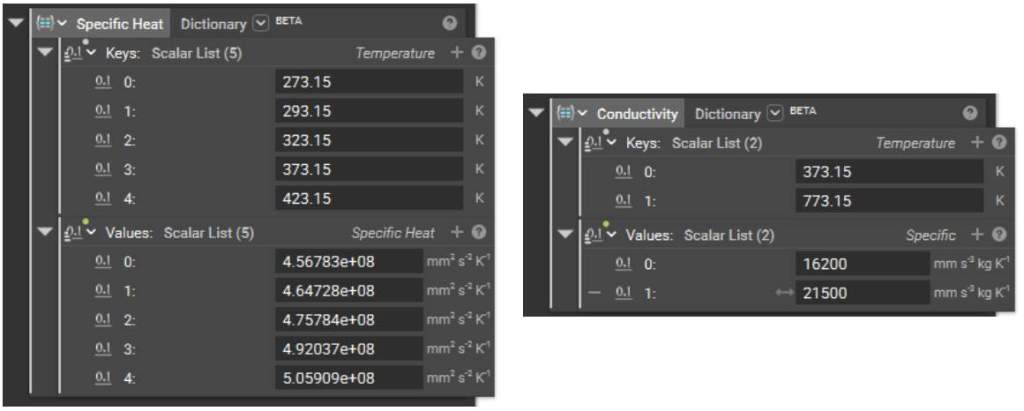 Using the **Dictionary**block to define *Specific Heat* and *Conductivity*for an isotropic material (also possible in a similar way for an orthotropic material).
We then input the dictionaries into the **Isotropic / Orthotropic Thermal Property** blocks.
**Note**: The option to input Dictionaries must be activated by using the block overload of the **Isotropic/ Orthotropic Thermal Property** blocks.
Using the **Dictionary**block to define *Specific Heat* and *Conductivity*for an isotropic material (also possible in a similar way for an orthotropic material).
We then input the dictionaries into the **Isotropic / Orthotropic Thermal Property** blocks.
**Note**: The option to input Dictionaries must be activated by using the block overload of the **Isotropic/ Orthotropic Thermal Property** blocks.
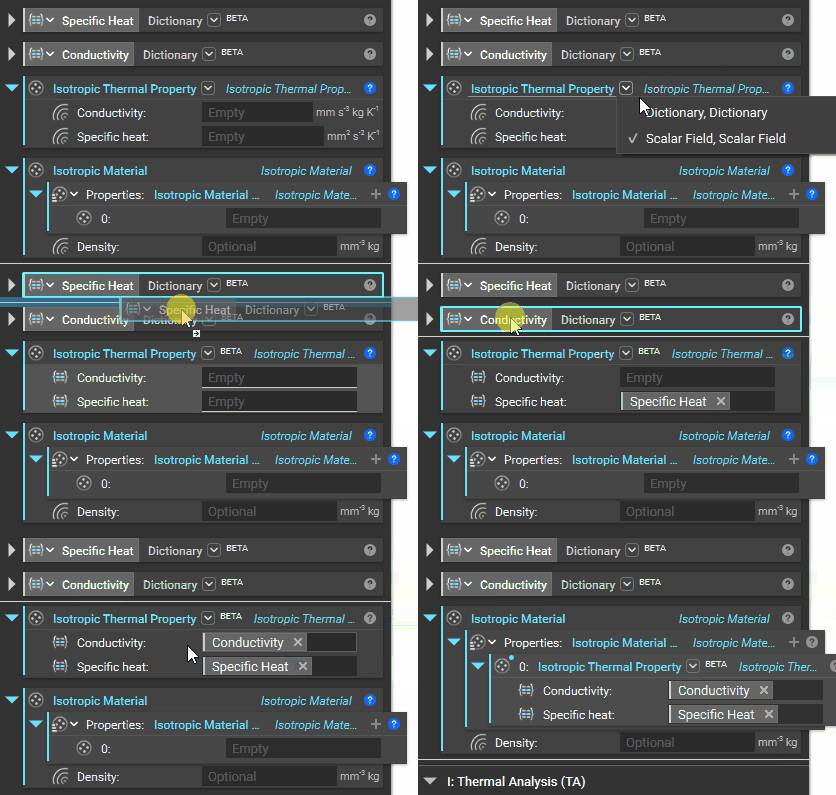 \*\*Example:\*\*for an isotropic material (also possible in a similar way for an orthotropic material)
***
## Material Library
In nTop, there are certain Sample Materials available in the *Design Analysis* tab in the ribbon. It should be noted that these materials do not have a defined thermal expansion (CTE) property, and must therefore be explicitly defined by the user before performing a thermal stress analysis.
\*\*Example:\*\*for an isotropic material (also possible in a similar way for an orthotropic material)
***
## Material Library
In nTop, there are certain Sample Materials available in the *Design Analysis* tab in the ribbon. It should be noted that these materials do not have a defined thermal expansion (CTE) property, and must therefore be explicitly defined by the user before performing a thermal stress analysis.
