
About this Block
What it does: The Flow Analysis block calculates time-averaged and instantaneous pressure and velocity fields using the Lattice Boltzmann Method (LBM). The Lattice Boltzmann Method (LBM) is a numerical approach that simulates fluid flow by the evolution of particle distribution functions. It recovers the Navier-Stokes equations with a mesoscopic model where particle distribution functions propagate and collide on a voxel grid. The method operates directly on implicit geometry definitions without generating body-fitted meshes. Its high parallel efficiency makes it ideal for GPU computation and large-scale simulations. Note: This block requires an NVIDIA GPU Common uses:- Predicting Pressure drop across complex geometries to minimize energy losses and optimize system designs.
- Simulating laminar, turbulent, and transitional flow regimes for comprehensive and accurate flow behavior analysis.
- Identifying unequal flow distributions, recirculation zones, and vortex structures to improve flow efficiency and system reliability.
- Calculating maximum flow velocity to detect critical high-speed zones and prevent erosion or mechanical failure.
- Detecting blockages and inefficiencies in flow paths to enhance fluid distribution and reduce pressure losses.
- Ensure that these requirements are met for the block to run
- The Boundary Conditions must contain at least one Pressure and Velocity Boundary condition.
- The Virtual Model must contain a Fluid Domain with a Fluid Attribute.
- The Fluid properties and density are specified with the Isotropic Material input to the Fluid Attribute block, whereas the Fluid’s kinematic viscosity is specified within th Isotopic Fluid Property. Kinematic viscosity is calculated as dynamic viscosity divided by fluid density.
- Every remaining boundary not defined as a Velocity or Pressure boundary is set to a no-slip boundary condition.
- The Pressure boundary serves as a reference value for system pressure. The simulation only considers pressure differences, so setting the pressure at an outlet to zero is the simplest approach and gives correct results if the fluid density corresponds to the static pressure level expected in the system.
- The Velocity at an inlet is given as a vector in global space. The magnitude of the velocity can be determined by dividing a volume flow rate by the inlet boundary area.
- Cell Regions: Translates continuous geometry into a discrete voxel grid and stops before any physics calculations, resulting in a cell region distribution before a real run.
- Potential Flow: Runs the mesh generation plus a fast, simplified physics calculation (Laplace equation) to establish a starting guess. Best for debugging boundary conditions and ensuring the flow path is connected from inlet to outlet without waiting for a heavy solve.
- Full Analysis (Default): Runs the entire pipeline — meshing, initialization, and the full Lattice Boltzmann Method iteration until steady state. Best for getting your final, complete CFD results.
- The flow analysis uses a uniform Cartesian mesh, defined by a single parameter: Cell Size.
- For quantitative results, use at least seven cells to resolve the smallest flow diameter, gap, or hole; for turbulent boundary layers, 20+ cells are recommended.
- At least 3 cells should resolve the smallest flow features for qualitative results.
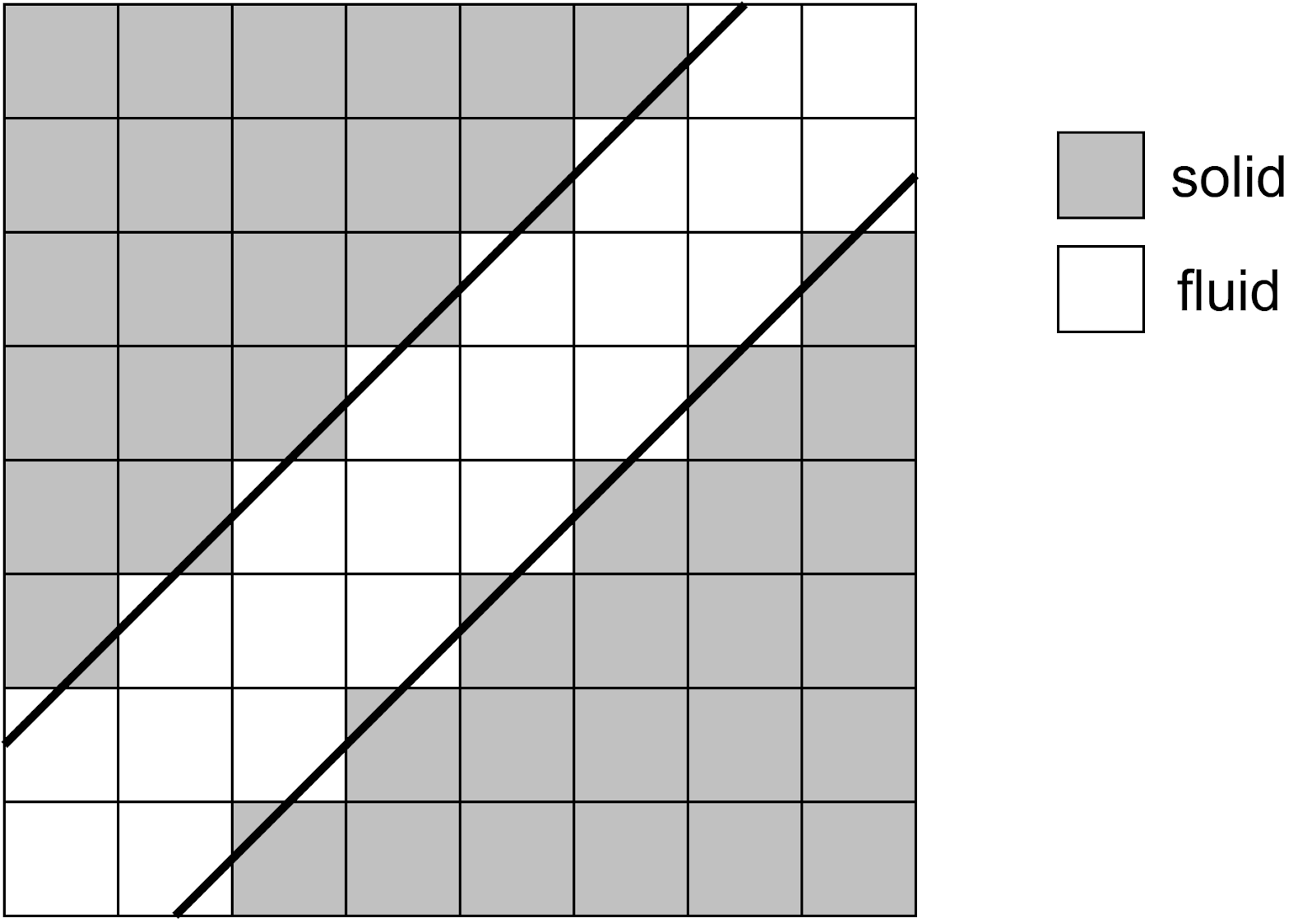
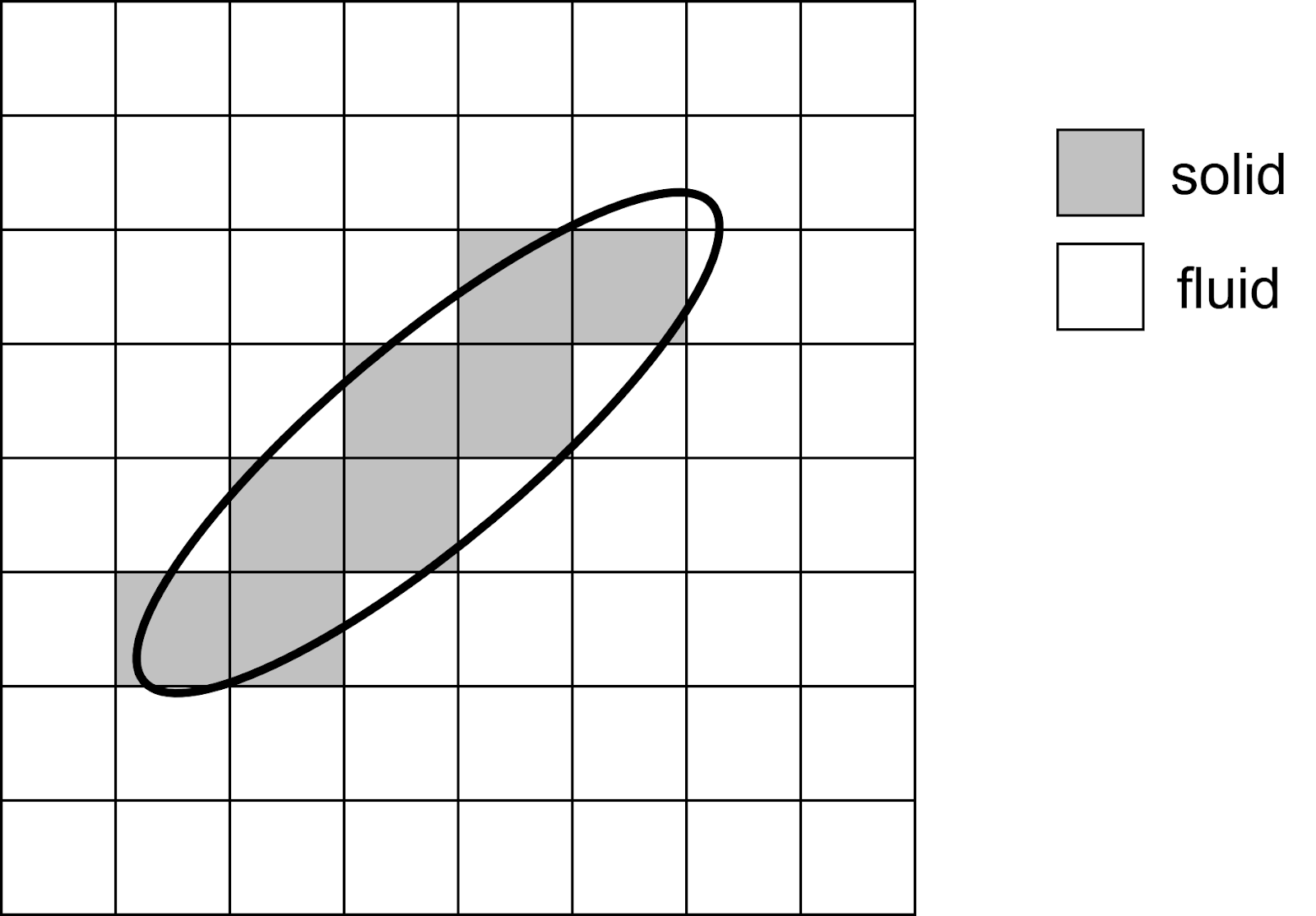
- Solid structures should be resolved with at least 2 cells.
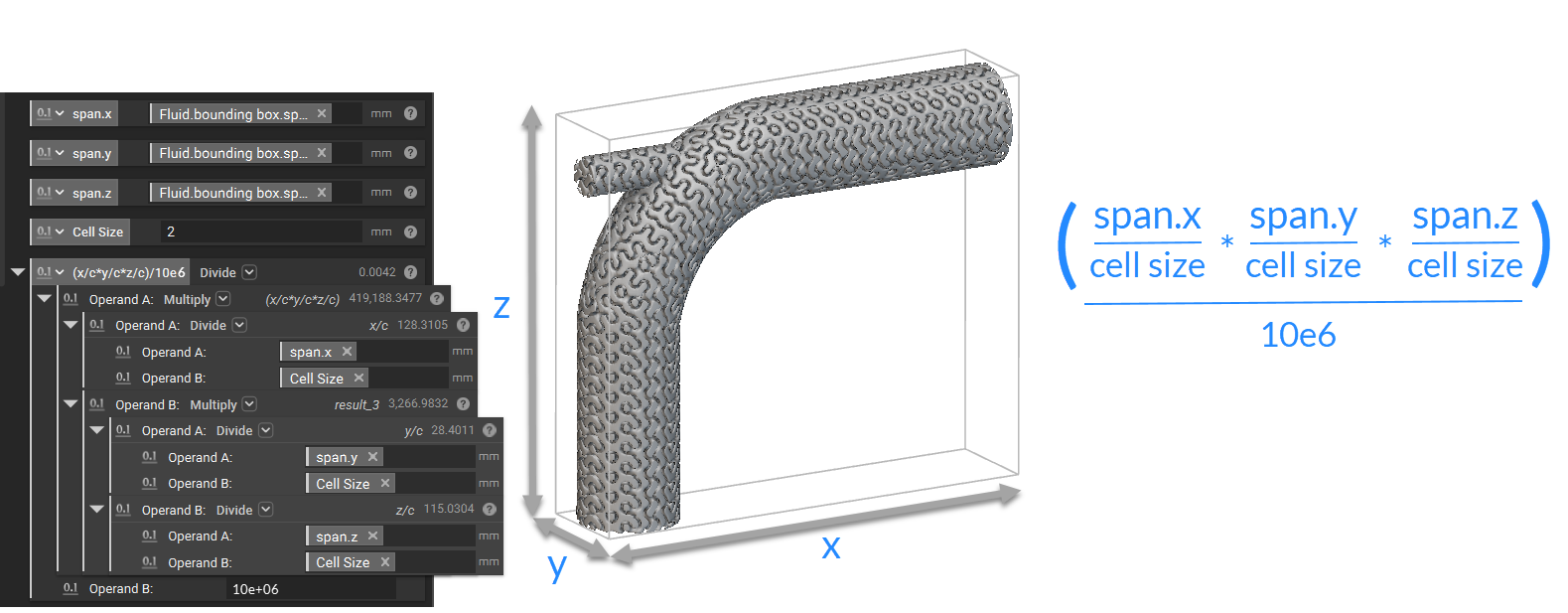
- Memory estimation: Ten million cells require approximately one GB of dedicated GPU memory. The following calculation provides a conservative estimate of the required GPU memory (in GB). Note that a Conjugate Heat Transfer Analysis requires approximately 40% additional memory.
- The Lattice Boltzmann Method (LBM) is transient by nature and uses a time-stepping solution scheme.
- The simulation runs until the results become statistically steady-state or reach a maximum time.
- The HUD and block properties include the time-averaged and instantaneous results from the last time step. The instantaneous result is the first field, and the time-averaged result is the second field.
- The instantaneous velocity and pressure fields capture all unsteady fluctuations at a given moment, including turbulence structures.
- The time-averaged fields smooth out these fluctuations by averaging over time, revealing the mean flow structure.
- Fluid solver diverged: The numerical solver can diverge for multiple reasons, such as incorrect boundary conditions, initial conditions, or cell size input. Please check your setup and modify these parameters to ensure they are correct.
- Voxelization fails for the implicit body in boundary condition list element X: The boundary condition is set up incorrectly. Please check to ensure the boundary condition is selected correctly.
Example
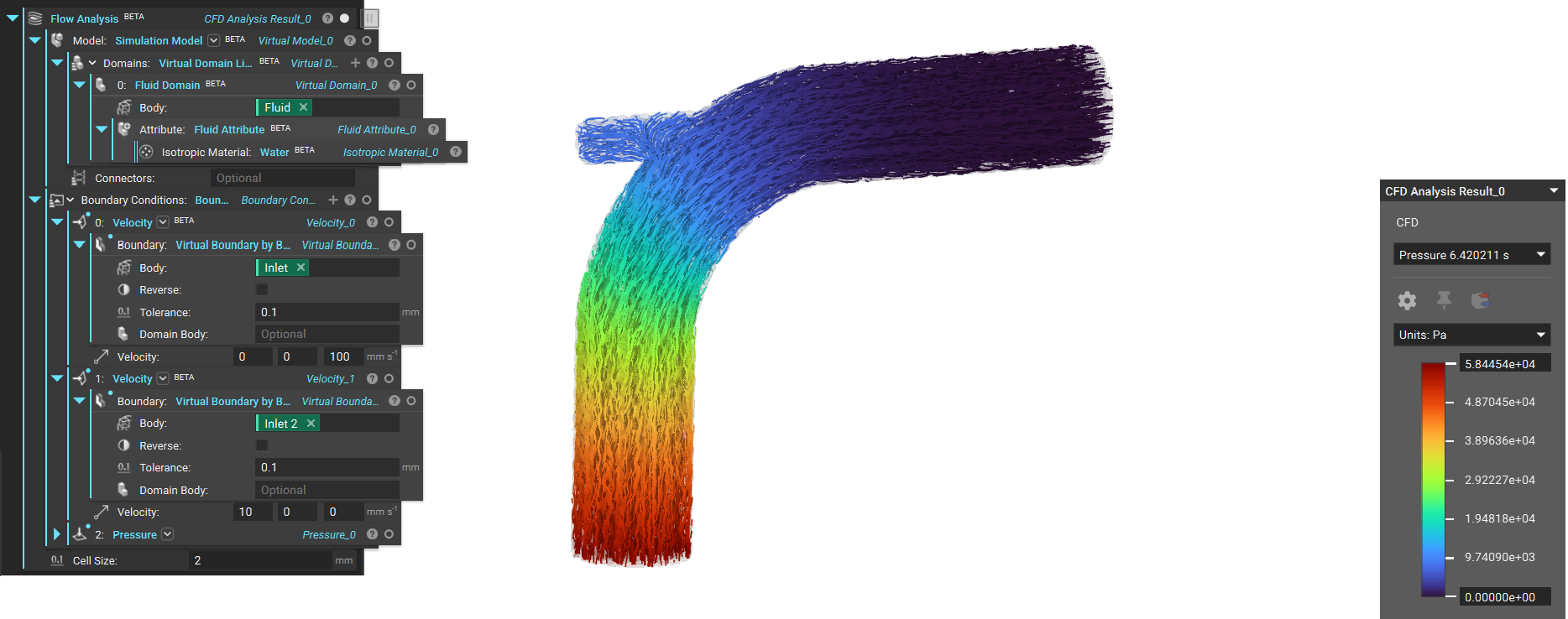 Example File
Calculates the pressure and velocity on a Virtual Model. The solution uses a Lattice Boltzmann Method. A transient simulation is initiated and continues until the flow reaches a statistically steady state, then returns time-averaged pressure and velocity fields. Streamlines will be calculated on the time averaged velocity results. This block requires an NVIDIA GPU.