

What solver is used in nTop Fluids?
nTop Fluids uses the Lattice Boltzmann Method (LBM), a numerical approach that simulates fluid flow by evolving particle distribution functions. It recovers the Navier-Stokes equations with a mesoscopic model where particle distribution functions propagate and collide on a voxel grid. The method operates directly on implicit geometry definitions without generating body-fitted meshes.Key Principles
Lattice Boltzmann equation (LBE):
- f: discrete particle distribution function
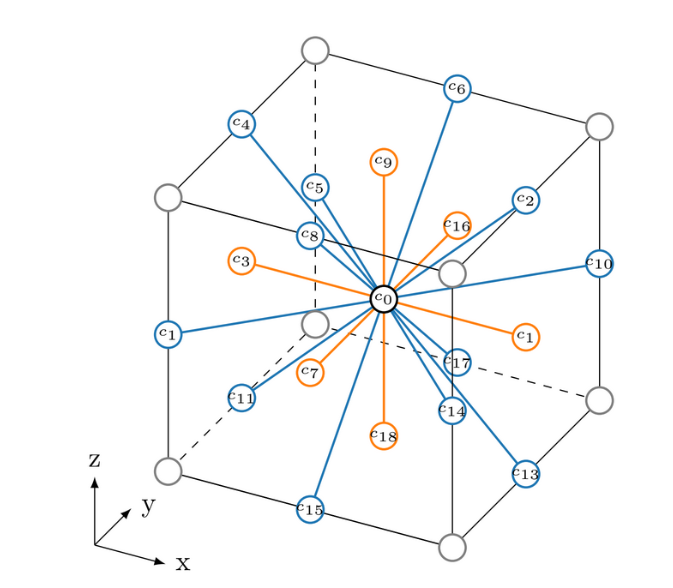
- c: discrete velocity
- x: position
- t: time
- Ω: collision operator
| D3Q19: A typical lattice velocity set for fluid simulations |
Advantages
- Simplicity and Scalability: LBM, like direct time stepping schemes, introduces artificial compressibility, simplifying the solution process and improving scalability.
- No Poisson Equation: Unlike traditional methods, LBM does not require solving the Poisson equation, which is computationally expensive due to its non-local nature.
- Highly Parallelizable: The LBM algorithm is characterized by very simple parallelization and high numerical efficiency, so that time-resolved flow simulations can be carried out significantly faster than with other solution methods.
- Easy Meshing: Generating Cartesian grids for LBM is much simpler and more automatable, removing the meshing bottleneck of many other approaches.
nTop Fluids (LBM) vs Traditional CFD
Common Applications
- Pressure drop prediction across complex geometries to minimize energy losses and optimize system designs.
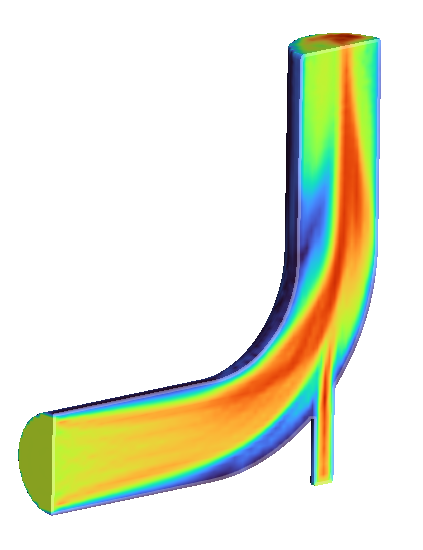
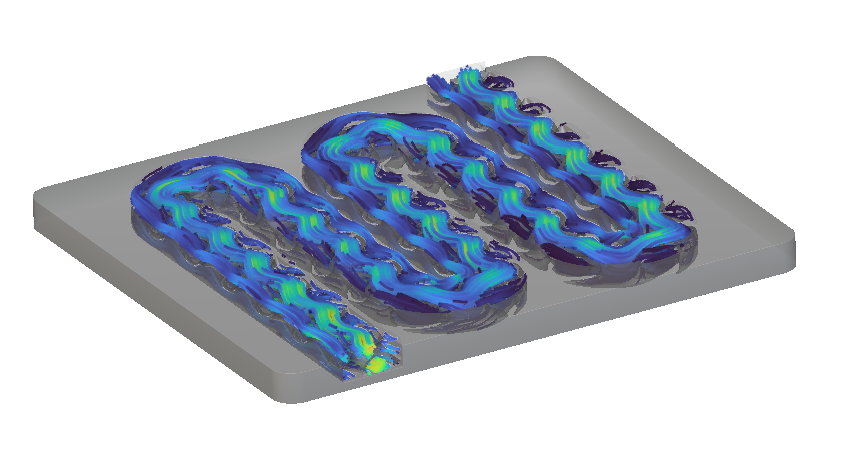
- Simulation of laminar, turbulent, and transitional flow regimes for comprehensive and accurate flow behavior analysis.
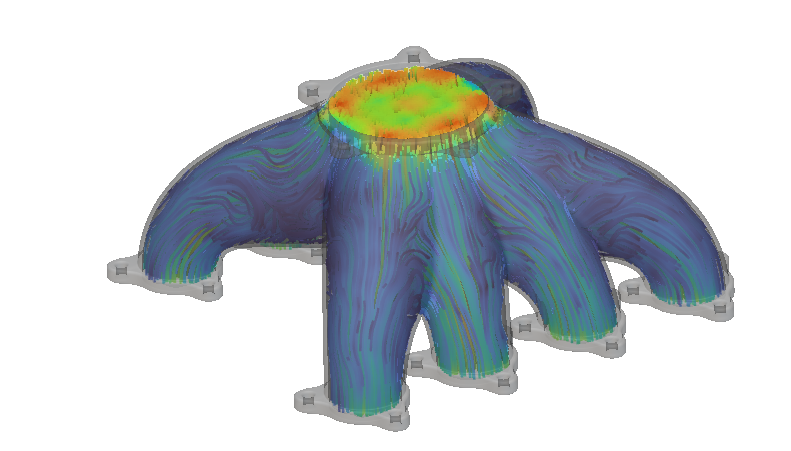
- Identification of unequal flow distributions, recirculation zones, and vortex structures to improve flow efficiency and system reliability.
- Calculation of maximum flow velocity to detect critical high-speed zones and prevent erosion or mechanical failure.
- Detection of blockages and inefficiencies in flow paths to enhance fluid distribution and reduce pressure losses.
 |  |  |