
Scalar, Scalar, Scalar, Scalar, Scalar, Continuity Enum
Scalar, Scalar, Scalar, Scalar, Scalar, Easing Enum, Easing Direction Enum, Scalar, 6.2.0
Scalar Field, Scalar Field, Scalar Field, Scalar Field, Scalar Field, Continuity Enum
Scalar Field, Scalar Field, Scalar Field, Scalar Field, Scalar Field, Easing Enum, Easing Direction Enum, Scalar, 6.2.0
About this Block
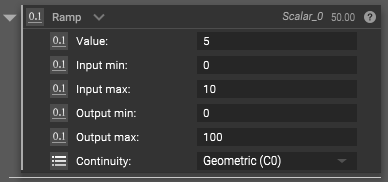
The Ramp block allows you to scale values from one range, within the input min and max, to its relative value within an output range. For example, an input value of 5 ramped from an input range of 0 to 10 results in 50 when the output range is 0 to 100. The input value and the ramp output are both halfway between their respective min and max bounds.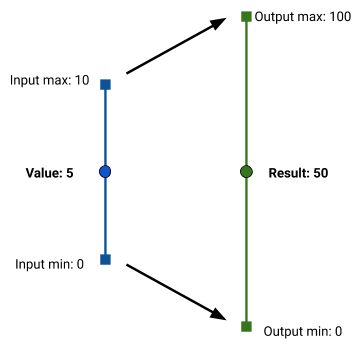
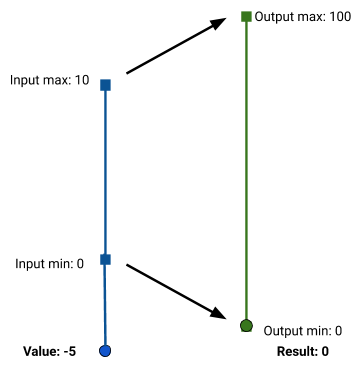
 When the input value falls below the Input min or above the Input max, the output value is set to the Output min, or Output max, respectively. This is referred to as a clamped bound.
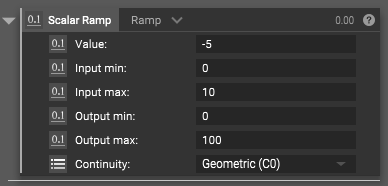 The ramp process can be performed on singular scalar values, or entire scalar fields. To change the block’s type, click on the chevron next to the ‘Ramp’ block title, and select from the drop-down menu.
When ramping with scalar fields, we’re able to take the qualitative shape of an input field and give it new quantitative values. In the example below, we’ve effectively scaled the distance field from a plane up by a factor of 2.
The ramp process can be performed on singular scalar values, or entire scalar fields. To change the block’s type, click on the chevron next to the ‘Ramp’ block title, and select from the drop-down menu.
When ramping with scalar fields, we’re able to take the qualitative shape of an input field and give it new quantitative values. In the example below, we’ve effectively scaled the distance field from a plane up by a factor of 2.
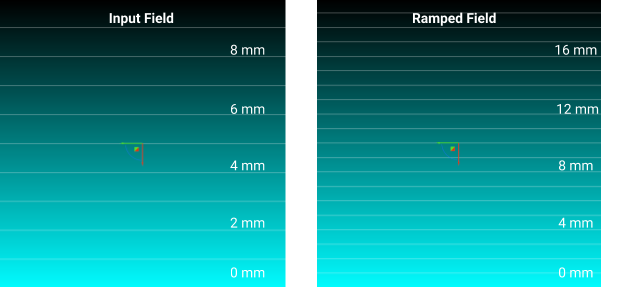
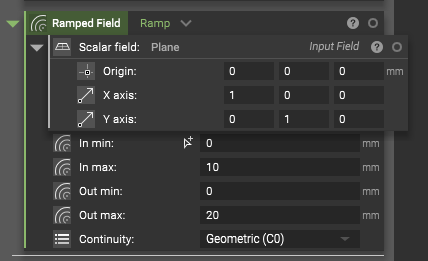 Ramping can be used in conjunction with any block that accepts a scalar field input in order to make the effect of that block spatially varying. In the example below, we thicken a cylinder by an amount that changes based on the distance from a plane.
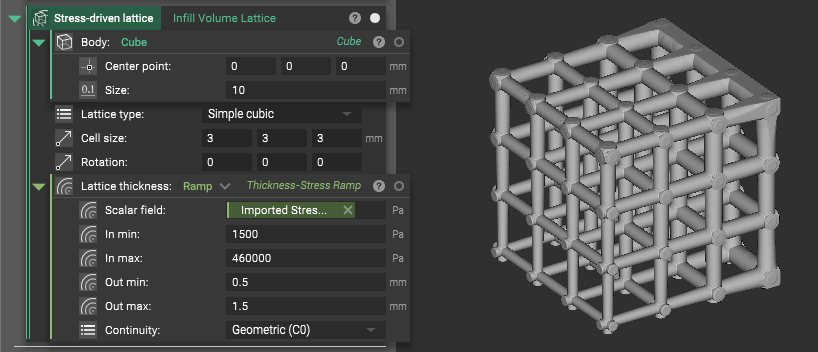
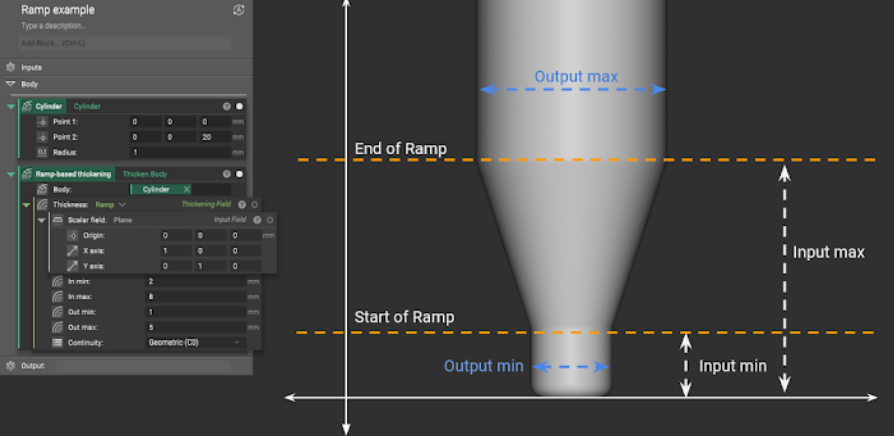 The units of the input value, input min, and input max, must all match. The output min and max must also match each other, but they can have a different set of units from the inputs. This allows you to convert, for example, a stress field in Pa into a field defining a lattice thickness in mm.
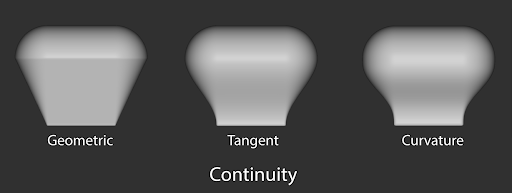
 The Continuity input dictates how values are interpolated between the min and max ranges. The images below show the difference between the three options.