

About this Block
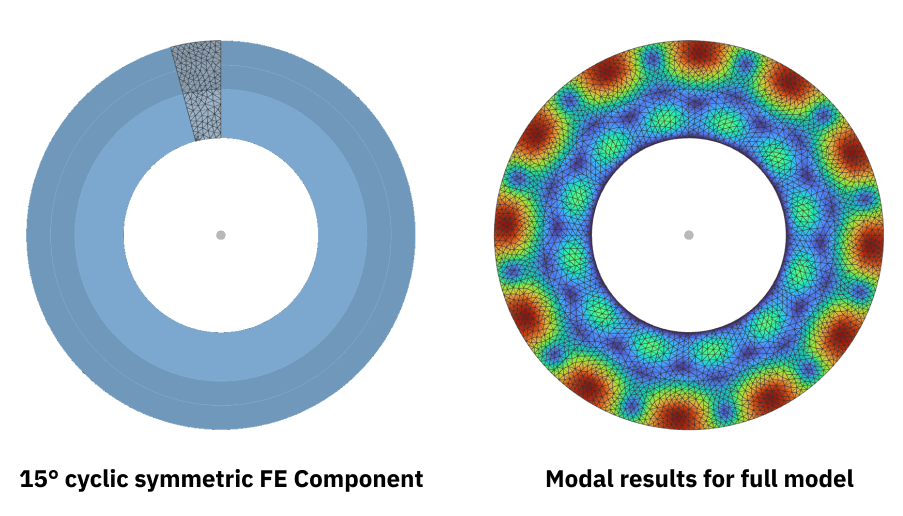
What it does: Enables computational speed up by performing an analysis on a sector of your model that is cyclically symmetrical, instead of solving on the entire model. When leveraging cyclic symmetry to reduce the overall model size, you can still visualize the results on the full model. Common uses:- Modal Analysis, and Static Analysis.
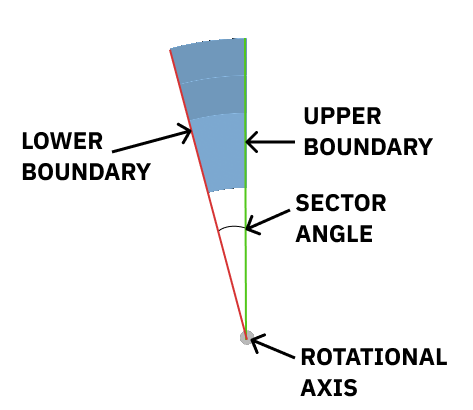
- Acts similar to the Tie Constraint block, since it ties the degrees of freedom of the upper boundary to the lower boundary.
- For generalized loading conditions acting on a cyclic symmetric structure, the force and displacement are approximated by a Fourier Series and harmonic analysis.
- The Harmonic count input is the maximum harmonic index to use in the series, and it physically represents the maximum number of variations in the displacement of a point spaced by the sector angle, or nodal diameter. If N equals the number of sectors in the full 360° model, the range of the harmonic count input is zero to N/2 (if N is even) and (N-1)/2 (if N is odd).
- When reviewing modal results with the cyclic symmetry constraint, the mode frequencies and harmonic index are displayed in the HUD legend.
- Although it is not necessary, you can create a conformal mesh between the upper and lower boundaries of the sector using the Remesh Surface with Cyclic Symmetry block. In some cases this yields more accurate results because each node on the upper boundary is tied to exactly one node on the lower boundary, and a multipoint constraint is not required.
Example File
Download Example: Cyclic Symmetry Use the Cyclic Symmetry block on a sector of your model and run a Modal and Static analysis. This example meshes the sector using the Remesh Surface with Cyclic Symmetry block.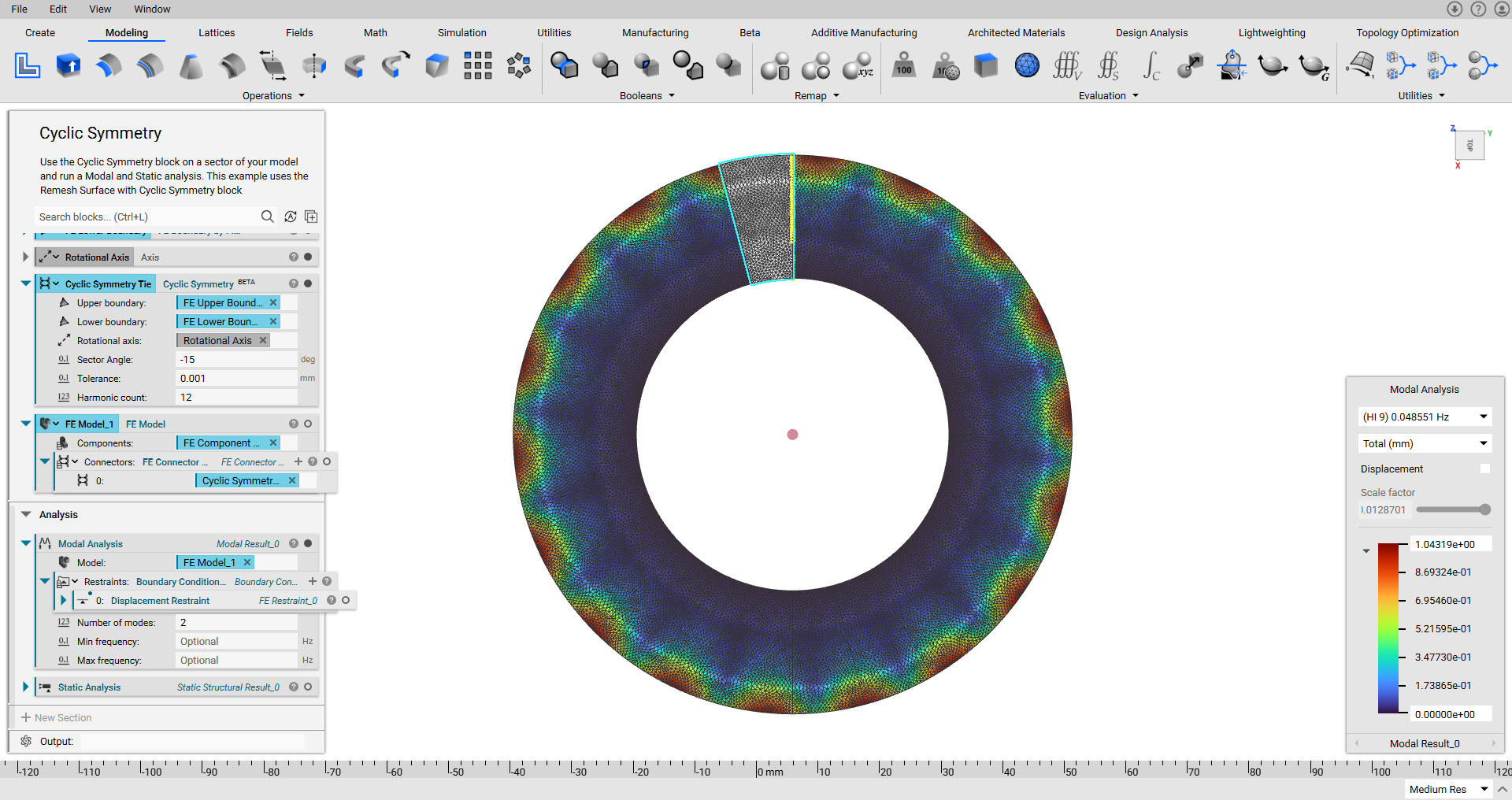
Creates a cyclic symmetry constraint between the upper and lower boundaries of the sector.