

About this Block
What it does: The Conic block creates an Implicit Body defined by an implicit conic section curve. The signed distance of a planar conic segment will be returned. The block uses three control points (Point 1, Point 2, and Point 3) and a Rho value to define the curve’s shape.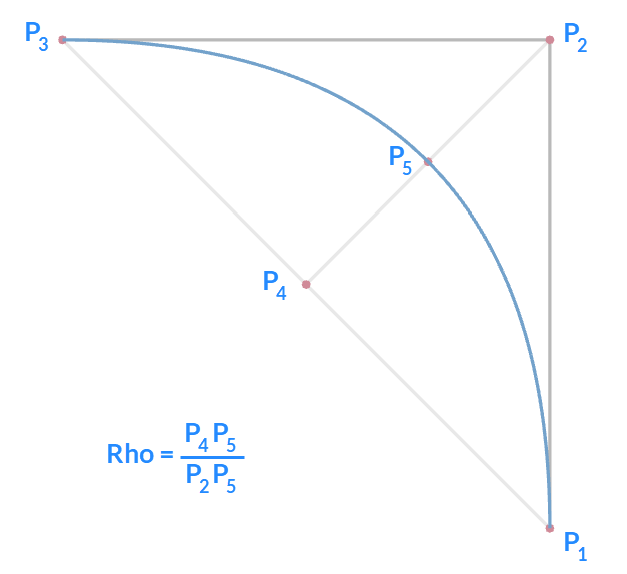
- The Conic block takes input of Point 1, Point 2, Point 3, Rho, and the Coordinate Space to create the conic section. Point 4 is the midpoint of the chord between Point 1 and Point 3. Point 5 is where the curve intersects the chord between Point 4 and Point 2.
- You can use the Vector Field from Components block to create your control point vector fields and use a Ramp block to vary rho value.
- Designing aerodynamic profiles for wings, fuselages, and other vehicle bodies.
- Modeling smooth transitions in components like ducts, inlets, and nozzles to manage fluid flow.
- Creating architectural features like arches and curved facades.
- For advanced applications, you can use a Ramp block to vary the Rho value, which will change the curve’s shape across a spatial domain.
- You would need to combine it with a Boolean Intersect block to create a solid since the block only outputs the implicit surface.
- Rho Parameter Values. The Rho value defines the “bulge” or shape of the conic curve as it’s pulled toward Point 2.
Example File
Download Example: Conic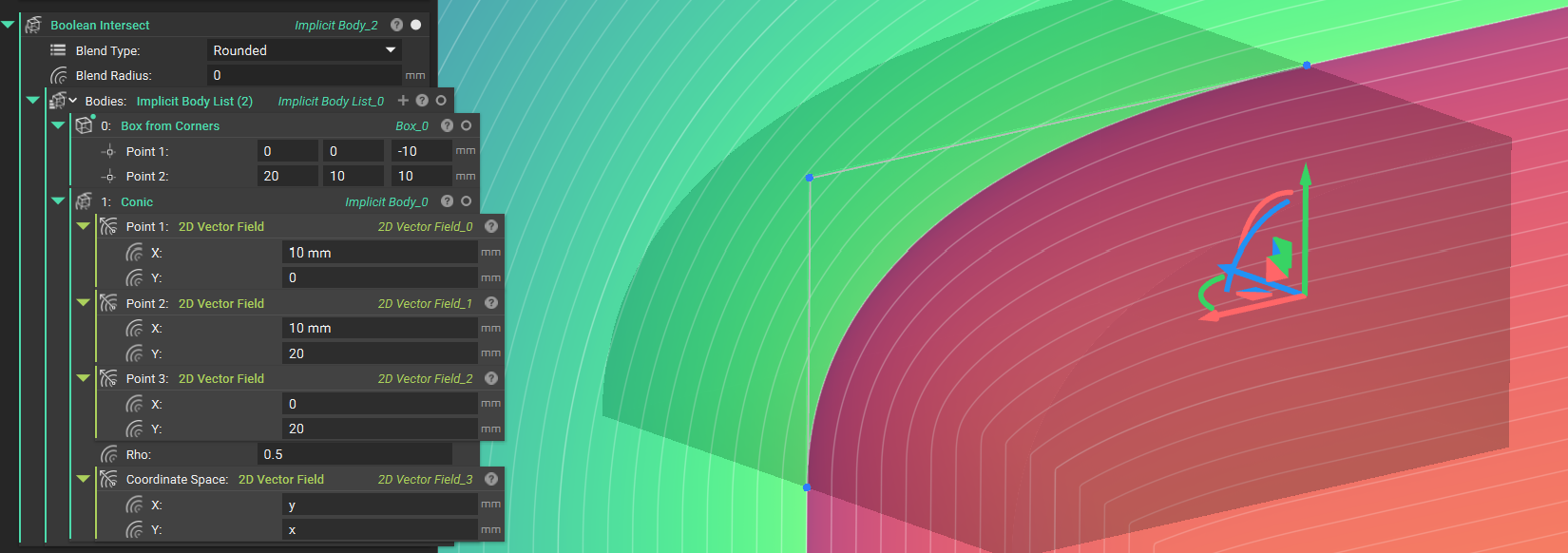
Create a conic section distance field. The signed distance of a planar conic curve will be returned.