
FE Mesh, Isotropic Material, Choice, Choice, Scalar, Scalar Field, Scalar Field, Scalar Field, Scalar, Scalar Field
FE Mesh, Isotropic Material, Choice, Choice, Scalar, Scalar Field, Scalar Field, Scalar Field, Scalar, Scalar Field, 1.1.0
FE Mesh, Isotropic Material, Choice, Choice, Scalar, Scalar Field, Scalar Field, Scalar Field, Scalar, Scalar Field, 1.2.0
About this Block
The Parametric Lattice Domain block creates a Parametric FE Domain parameterized with design parameters for a variably thickened lattice. The block uses a FE Volume Mesh as an input mesh to define the design space. This block allows you to select any currently available lattice types with constant cell size. This block is an input to the Parametric FE Model block. After field optimization, the optimized values for the lattice thickness is applied to the design space. The Parametric Lattice Domain uses homogenization data from a discretized beam thickness/cell size ratio set. There are two available options for Boundary. The Conformal one will warp the outer cells to fill the design space, whereas the Trimmed option would trim the lattice to the design space.
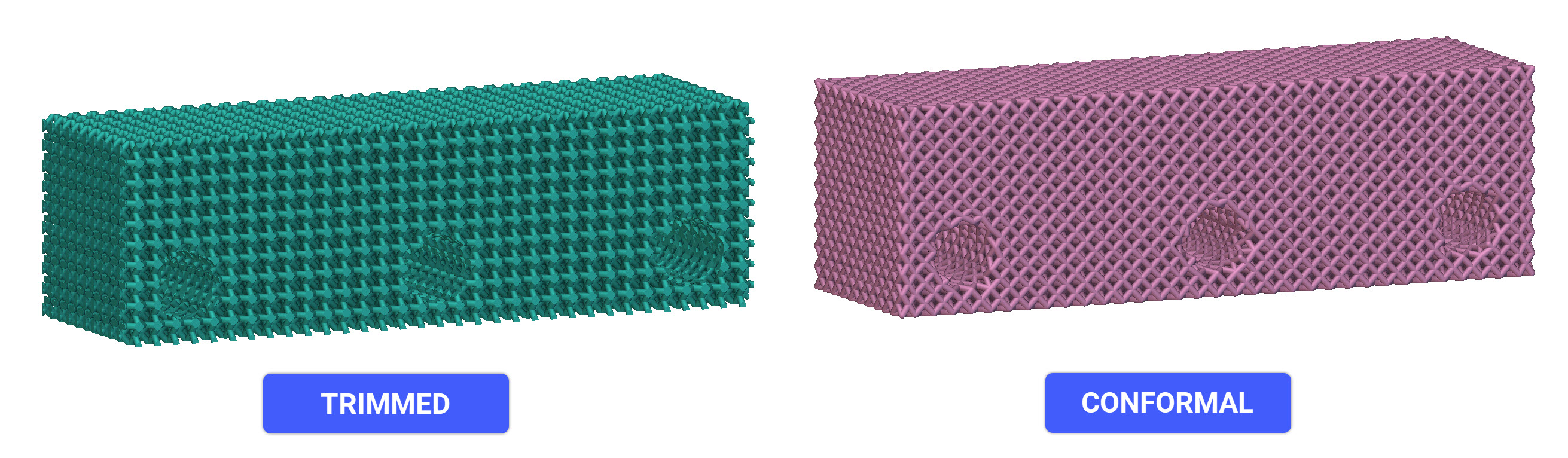
Common uses: This block is an input to the Parametric FE Model block.
Once the Parametric Lattice Domain is generated, a HUD appears in the Viewport with several options for visualizing the results.
- Implicit View - allows you to view the resulting geometry.
- Property Fields - allows a user to view the mechanical properties of the structure across the design space before performing field optimization.
- State Fields - allows a user to view values of the design parameters across the design space before performing the field optimization.
- Adjust the Initial thickness to view the geometry generated for the Upper/Lower bounds to ensure printability before running a field optimization.
- Adjust the Density threshold to alter the lattice thickness and design space during optimization. The threshold value will remove less significant design space volume. A value of 0 will remove no design space and behave solely as a thickness optimization. A value of 0.3 will remove areas with less than a 30% volume fraction.
- The maximum allowable lattice thickness is 1.5 times the cell size. This is limited due to the data collected, as most lattices reach solid volume before this threshold.
Example File
Download Example: Parametric Lattice Domain
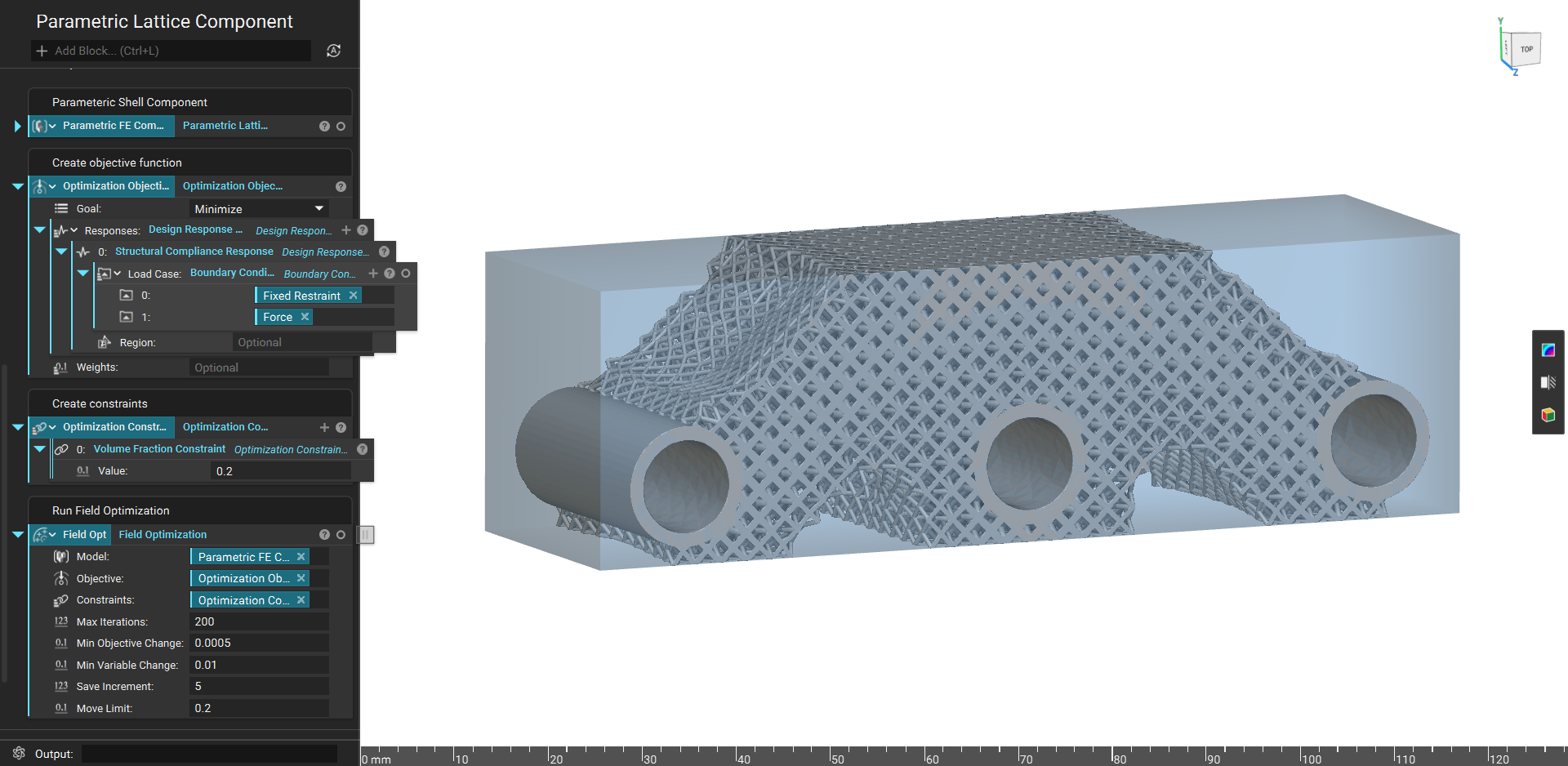
FE Mesh, Isotropic Material, Choice, Choice, Scalar, Scalar Field, Scalar Field, Scalar Field, Scalar, Scalar Field
Create a Parametric FE Domain for a periodic lattice with the following design parameters: lattice thickness. The material model is homogenization-based so the model accuracy will improve as the cell size is reduced. Inputs| Name | Type | Description |
|---|---|---|
| Mesh | FE Mesh | The finite element mesh that defines the design space. |
| Material | Isotropic Material | Material that the periodic lattice is comprised of. |
| Unit cell | Choice | The unit cell used to create the periodic lattice. |
| Boundary behavior | Choice | Determines how the periodic lattice will fill the design space. conformal option will warp the outer cells to fill the design space. trimmed option will trim the lattice to the design space. |
| Cell size | Scalar | The cell size for the periodic lattice. |
| Min thickness | Scalar Field | The minimum allowable lattice thickness. |
| Max thickness | Scalar Field | The maximum allowable lattice thickness. |
| Initial thickness | Scalar Field | The initial lattice thickness. this defines the starting point of the optimization. values exceeding the min/max bounds will be clamped. |
| Density threshold | Scalar | The threshold signifies a lower bound limit on lattice porosity (=relative density) under which the lattice will be eliminated from the design space. maintaining a 0 threshold will fill the entire domain with a lattice in the optimization process. a threshold between zero and one will remove design boundary in parallel to the lattice optimization, removing less important material. |
| Filter size | Scalar Field | A length measure used to control the smoothness of the design parameter field. a lower bound of 0 will be enforced. if not specified, a default will be estimated based on the model size. |
FE Mesh, Isotropic Material, Choice, Choice, Scalar, Scalar Field, Scalar Field, Scalar Field, Scalar, Scalar Field, 1.1.0
Create a Parametric FE Domain for a periodic lattice with the following design parameters: lattice thickness. The material model is homogenization-based so the model accuracy will improve as the cell size is reduced. Inputs| Name | Type | Description |
|---|---|---|
| Mesh | FE Mesh | The finite element mesh that defines the design space. |
| Material | Isotropic Material | Material that the periodic lattice is comprised of. |
| Unit cell | Choice | The unit cell used to create the periodic lattice. |
| Boundary behavior | Choice | Determines how the periodic lattice will fill the design space. conformal option will warp the outer cells to fill the design space. trimmed option will trim the lattice to the design space. |
| Cell size | Scalar | The cell size for the periodic lattice. |
| Min thickness | Scalar Field | The minimum allowable lattice thickness. |
| Max thickness | Scalar Field | The maximum allowable lattice thickness. |
| Initial thickness | Scalar Field | The initial lattice thickness. this defines the starting point of the optimization. values exceeding the min/max bounds will be clamped. |
| Density threshold | Scalar | The threshold signifies a lower bound limit on lattice porosity (=relative density) under which the lattice will be eliminated from the design space. maintaining a 0 threshold will fill the entire domain with a lattice in the optimization process. a threshold between zero and one will remove design boundary in parallel to the lattice optimization, removing less important material. |
| Filter size | Scalar Field | A length measure used to control the smoothness of the design parameter field. a lower bound of 0 will be enforced. if not specified, a default will be estimated based on the model size. |
FE Mesh, Isotropic Material, Choice, Choice, Scalar, Scalar Field, Scalar Field, Scalar Field, Scalar, Scalar Field, 1.2.0
Create a Parametric FE Domain for a periodic lattice with the following design parameters: lattice thickness. The material model is homogenization-based so the model accuracy will improve as the cell size is reduced. Inputs| Name | Type | Description |
|---|---|---|
| Mesh | FE Mesh | The finite element mesh that defines the design space. |
| Material | Isotropic Material | Material that the periodic lattice is comprised of. |
| Unit cell | Choice | The unit cell used to create the periodic lattice. |
| Boundary behavior | Choice | Determines how the periodic lattice will fill the design space. conformal option will warp the outer cells to fill the design space. trimmed option will trim the lattice to the design space. |
| Cell size | Scalar | The cell size for the periodic lattice. |
| Min thickness | Scalar Field | The minimum allowable lattice thickness. |
| Max thickness | Scalar Field | The maximum allowable lattice thickness. |
| Initial thickness | Scalar Field | The initial lattice thickness. this defines the starting point of the optimization. values exceeding the min/max bounds will be clamped. |
| Density threshold | Scalar | The threshold signifies a lower bound limit on lattice porosity (=relative density) under which the lattice will be eliminated from the design space. maintaining a 0 threshold will fill the entire domain with a lattice in the optimization process. a threshold between zero and one will remove design boundary in parallel to the lattice optimization, removing less important material. |
| Filter size | Scalar Field | A length measure used to control the smoothness of the design parameter field. a lower bound of 0 will be enforced. if not specified, a default will be estimated based on the model size. |

