
FE Mesh, Isotropic Material, Scalar Field, Scalar Field, Scalar Field, Scalar Field, Scalar Field, Scalar Field, Scalar Field

FE Mesh, Isotropic Material, Scalar Field, Scalar Field, Scalar Field, Scalar Field, Scalar Field, Scalar Field, Scalar Field, 1.1.0

About this Block

The Parametric Voronoi Domain block creates an FE Domain, parameterized with design parameters for a Voronoi lattice with variable cell size and lattice thickness. The block uses an FE Solid Mesh as an input Mesh. After field optimization, it will apply optimized values for the lattice thickness and cell size to the design space. The Parametric Voronoi lattices use a theoretical relationship between the relative density of an open-celled foam and the resulting mechanical properties. Common uses :
  • This block is an input to the Parametric FE Model block.
Once the Parametric Voronoi Domain is generated, a HUD appears in the Viewport with several options for visualizing the results.
  • Implicit View - allows you to view the resulting geometry.
  • Property Fields - allows a user to view the mechanical properties of the structure across the design space before performing field optimization.
  • State Fields - allows a user to view values of the design parameters across the design space before performing the field optimization.
  • The cell size is the average spacing between the center points of the Voronoi lattice.
  • You can use the initial value inputs to the domain blocks in 2 ways:
    • Adjust the Initial Beam Thickness and the Initial Cell Size to view the geometry generated for the upper/lower bounds to ensure printability before running a field optimization.
    • The starting point from which the optimization continues.

Example File

Download Example: Parametric Voronoi Domain Parametric Voronoi
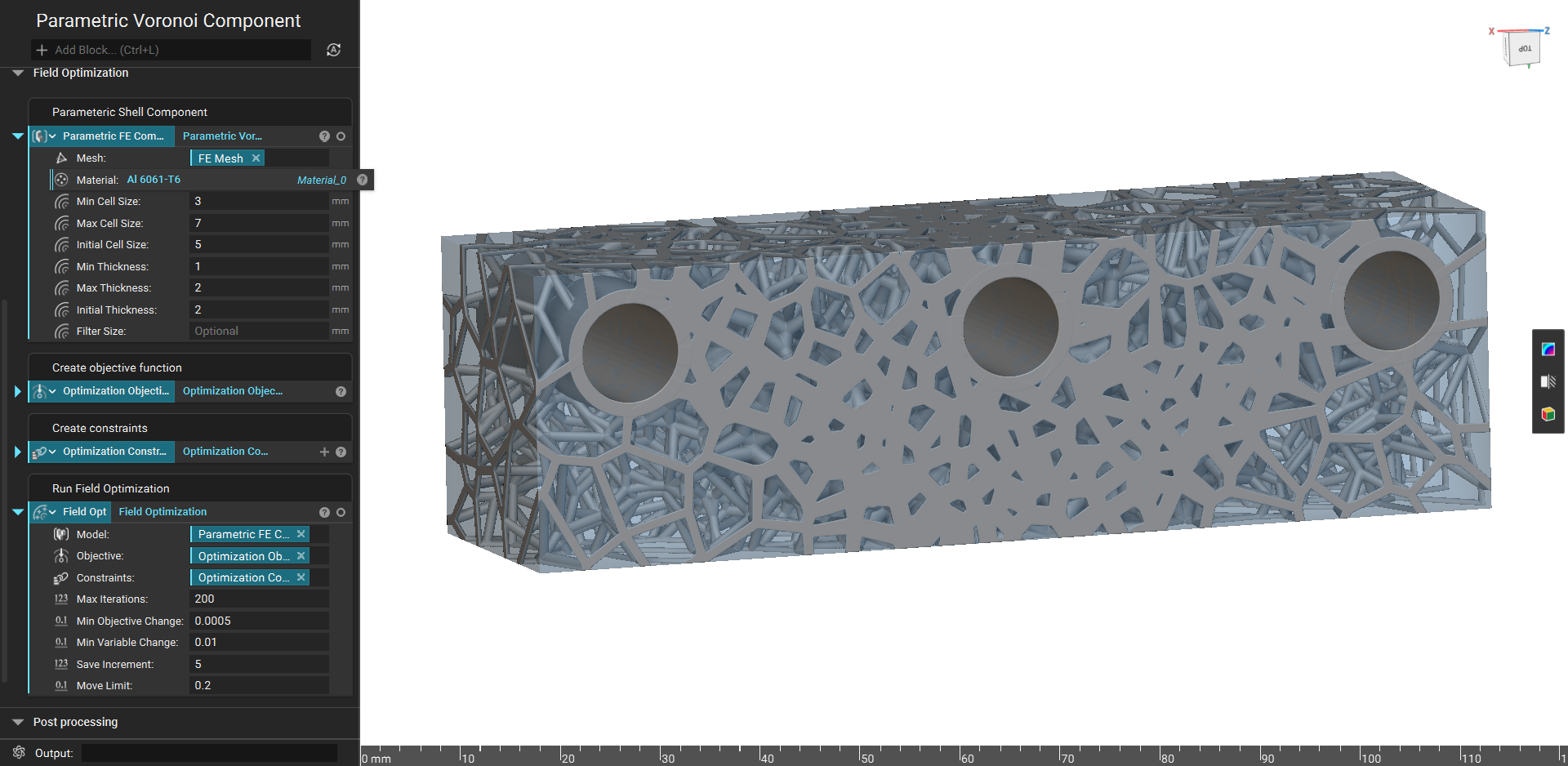
FE Mesh, Isotropic Material, Scalar Field, Scalar Field, Scalar Field, Scalar Field, Scalar Field, Scalar Field, Scalar Field

Create a Parametric FE Domain for a Voronoi Lattice with the following design parameters: cell size and beam thickness. The material model is homogenization-based so the model accuracy will improve as the cell size is reduced. Inputs
NameTypeDescription
MeshFE MeshThe finite element mesh that defines the design space.
MaterialIsotropic MaterialMaterial that the voronoi lattice is comprised of.
Min cell sizeScalar FieldThe minimum allowable cell size for the voronoi lattice.
Max cell sizeScalar FieldThe maximum allowable cell size for the voronoi lattice.
Initial cell sizeScalar FieldThe initial cell size for the voronoi lattice. this defines the starting point of the optimization. values exceeding the min/max bounds will be clamped.
Min thicknessScalar FieldThe minimum allowable beam thickness for the voronoi lattice.
Max thicknessScalar FieldThe maximum allowable beam thickness for the voronoi lattice.
Initial thicknessScalar FieldThe initial beam thickness for the voronoi lattice. this defines the starting point of the optimization. values exceeding the min/max bounds will be clamped.
Filter sizeScalar FieldA length measure that is used to control the smoothness of the design parameter field. a lower bound of 0 will be enforced. if not specified, a default will be estimated based on the model size.
Outputs

FE Mesh, Isotropic Material, Scalar Field, Scalar Field, Scalar Field, Scalar Field, Scalar Field, Scalar Field, Scalar Field, 1.1.0

Create a Parametric FE Domain for a Voronoi Lattice with the following design parameters: cell size and beam thickness. The material model is homogenization-based so the model accuracy will improve as the cell size is reduced. Inputs
NameTypeDescription
MeshFE MeshThe finite element mesh that defines the design space.
MaterialIsotropic MaterialMaterial that the voronoi lattice is comprised of.
Min cell sizeScalar FieldThe minimum allowable cell size for the voronoi lattice.
Max cell sizeScalar FieldThe maximum allowable cell size for the voronoi lattice.
Initial cell sizeScalar FieldThe initial cell size for the voronoi lattice. this defines the starting point of the optimization. values exceeding the min/max bounds will be clamped.
Min thicknessScalar FieldThe minimum allowable beam thickness for the voronoi lattice.
Max thicknessScalar FieldThe maximum allowable beam thickness for the voronoi lattice.
Initial thicknessScalar FieldThe initial beam thickness for the voronoi lattice. this defines the starting point of the optimization. values exceeding the min/max bounds will be clamped.
Filter sizeScalar FieldA length measure that is used to control the smoothness of the design parameter field. a lower bound of 0 will be enforced. if not specified, a default will be estimated based on the model size.
Outputs