Mesh, Scalar, Integer, Scalar, 2.0.0
Mesh, Scalar, Integer, Scalar, 2.1.0
Mesh, Scalar, Scalar, Regions
About this Block
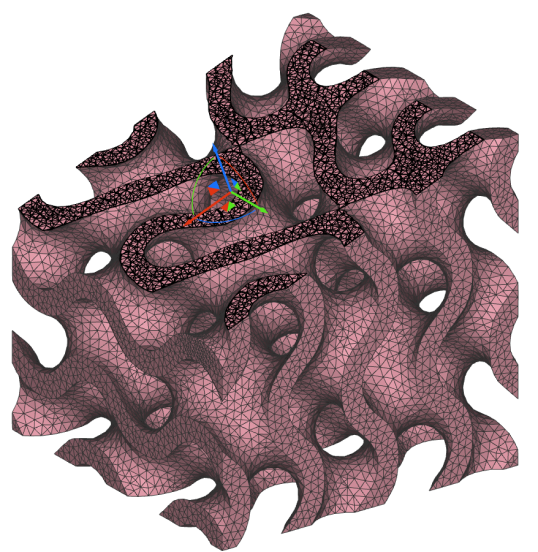
What it does: Creates a solid mesh from a surface mesh using a robust algorithm. It is tolerant of very low-quality inputs, converting them into FEA quality elements. This block can handle complex parts but is slower than the Volume Mesh block. Commons uses:- Converting complex surface meshes into solid meshes.
- Edge length isn’t a Scalar Field input. Therefore, it can’t vary throughout the mesh.
- Use the Remesh Surface block to clean up the mesh before using the Robust Tetrahedral Mesh block. When doing this, use the same Edge length in both blocks to easily create the 3D elements.
- If your part isn’t that complex, we recommend using the Volume Mesh block for faster results.
Example File
Download Example: Robust Tetrahedral Mesh
Mesh, Scalar, Integer, Scalar, 2.0.0
Mesh a solid domain with tetrahedral elements using algorithms that are tolerant to defects such as self-intersections. This function will remesh the boundary of the input domain to generate valid, high-quality elements. If the input domain is likely to be free of any defects, consider using the faster Volume Mesh block.Inputs
| Name | Type | Description |
|---|---|---|
| Domain | Mesh | The domain to mesh. |
| Edge length | Scalar | The target edge length of the generated elements. |
| Regularity factor | Integer | A number between 0 and 10 indicating the level of mesh optimization that will be done to improve the shape of the tets. A value of 0 indicates a minimum amount of optimization and a value of 10 indicates a high amount of optimization to achieve regular shaped tetrahedra. |
| Tolerance | Scalar | A tolerance that controls how closely the output mesh vertices must be to the input surface. If not provided, a default value is derived by multiplying the diagonal of the bounding box of the input geometry by 0.001. |
Outputs
| Type |
|---|
| Volume Mesh |
Mesh, Scalar, Integer, Scalar, 2.1.0
Mesh a solid domain with tetrahedral elements using algorithms that are tolerant to defects such as self-intersections. This function will remesh the boundary of the input domain to generate valid, high-quality elements. If the input domain is likely to be free of any defects, consider using the faster Volume Mesh block.Inputs
| Name | Type | Description |
|---|---|---|
| Domain | Mesh | The domain to mesh. |
| Edge length | Scalar | The target edge length of the generated elements. |
| Regularity factor | Integer | A number between 0 and 10 indicating the level of mesh optimization that will be done to improve the shape of the tets. A value of 0 indicates a minimum amount of optimization and a value of 10 indicates a high amount of optimization to achieve regular shaped tetrahedra. |
| Tolerance | Scalar | A tolerance that controls how closely the output mesh vertices must be to the input surface. If not provided, a default value is derived by multiplying the diagonal of the bounding box of the input geometry by 0.001. |
Outputs
| Type |
|---|
| Volume Mesh |
Mesh, Scalar, Scalar, Regions
Tetrahedralize a domain that may contain flaws in the input geometry.Inputs
| Name | Type | Description |
|---|---|---|
| Domain | Mesh | The domain to mesh. |
| Edge length | Scalar | The target edge length of the generated elements. |
| Tolerance | Scalar | A tolerance that controls how closely the output mesh vertices must be to the input surface. If not provided, a default value is derived by multiplying the diagonal of the bounding box of the input geometry by 0.001. |
| Regions | Mesh List | Regions whose boundaries will be included in the output mesh. |
Outputs
| Type |
|---|
| Volume Mesh |

