

Objective:
This article explains the various optimization algorithms available in the Parameter Optimization block and provides guidance on selecting the most suitable one for your design study.Applies to:
- Parameter Optimization
- Dependent Parameter
Procedure:
Choosing the correct algorithm is a crucial step that significantly impacts the speed and quality of your optimization results. There are four distinct algorithms for Parameter Optimization. Understanding how each one works is key to making the right choice.Grid
- This method performs uniform grid sampling. It performs an exhaustive search by evaluating every possible combination of parameter values on a predefined grid. You specify the total number of “steps” for each variable, and the optimizer tests them all.
- This algorithm is Ideal for understanding the design space before using an additional optimization algorithm.
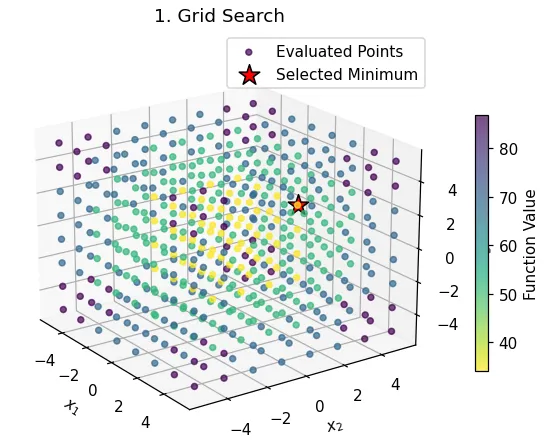 | What you see: A perfect 3D cube of points. The algorithm tests every single point on this predefined grid. The final result (the red star) is simply the point on the grid that had the lowest value in the case of a minimization problem.. Takeaway: This method is simple and exhaustive, but scales terribly. For our 3D problem with 8 values per axis, it ran 8^3 = 512 calculations. For a 10D problem, it would be 8^10 (over 1 billion), making it completely impractical for some real-world problems. It will also miss the true minimum if it falls between the grid points. |
Global
- This method uses a global optimization algorithm. It is a sophisticated method that splits its effort between exploring new, untested regions of the design space (exploration) and performing local optimization on promising regions (exploitation).
- This algorithm is suitable for finding a global maximum/minimum among multiple local maximums or minimums.
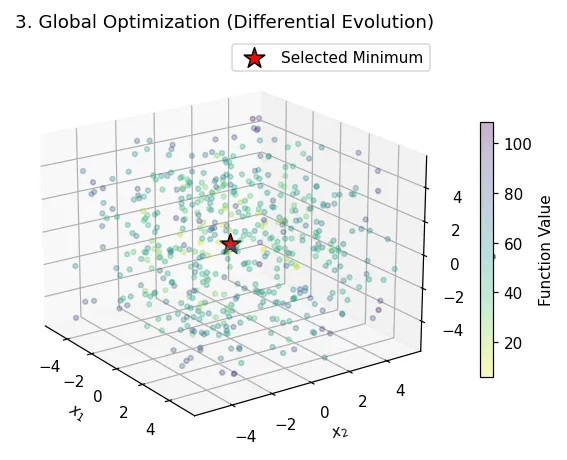 | What you see: A large “cloud” of points scattered across the entire 3D space, with a mix of colors. This shows the algorithm is actively exploring new, random regions. The final red star is correctly placed at the true global minimum (0,0,0). Takeaway: This algorithm is designed to solve difficult problems. It intelligently balances exploration (sampling new regions to find the best valley) with exploitation (using local search to find the bottom of that valley). It is highly effective at avoiding local traps and finding the true global minimum. |
Local
- This method uses a local BOBYQA technique. BOBYQA (Bound Optimization BY Quadratic Approximation) builds a smooth, quadratic approximation of your objective function within the local region of your current solution and seeks the minimum of that approximation.
- This algorithm is suitable when you are looking for a minimum/maximum of a simple convex/concave optimization problem.
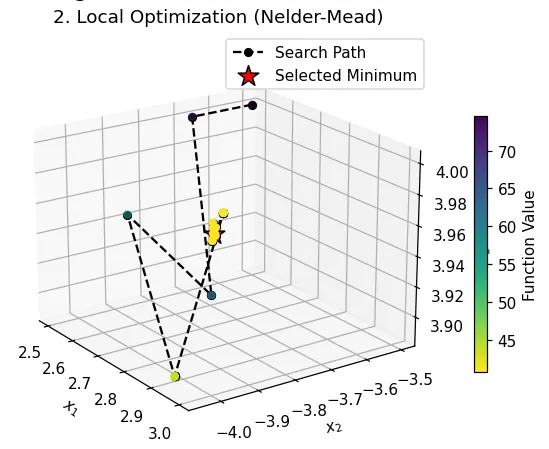 | What you see: A black search path starting from its initial guess. The algorithm intelligently creates a smooth model of the “valley” it’s in and follows it downhill to the bottom. The final red star is at a local minimum, but not the true global one at (0,0,0). Takeaway: This is a powerful and efficient local optimizer that doesn’t require gradients and can handle a certain level of noise or non-smoothness in functions. However, it is entirely dependent on its starting point and has no way to escape the first valley it finds. |
Smooth
- This method is a Gradient-Based (LBFGS) optimization. It uses a finite difference approximation to calculate the gradients of your objective function and then follows these gradients to find a minimum.
- This algorithm is best used when your dependent parameters are smooth and continuous.
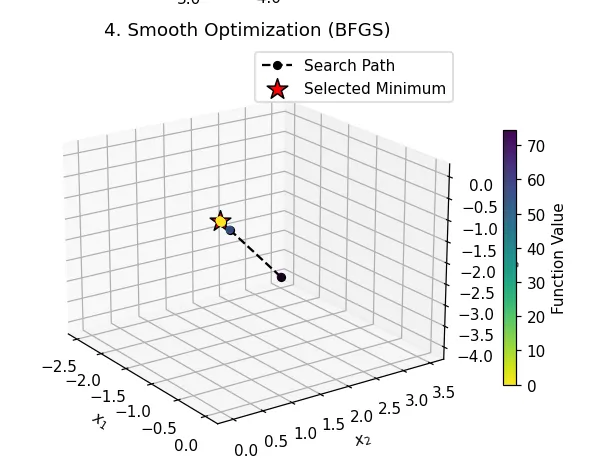 | What you see: A short, efficient black search path. The algorithm uses the function’s slope (gradient) to find the steepest path downhill from its starting point. Like BOBYQA, it quickly finds the bottom of the nearest valley and gets stuck there. Takeaway: This method performs very well and is the standard for “smooth” problems (common in machine learning). It may scale poorly, however, when dealing with too many parameters due to the finite difference computation for gradients. In addition, its reliance on the local gradient makes it blind to the bigger picture, and it will get trapped in the first local minimum it encounters. Show less |