
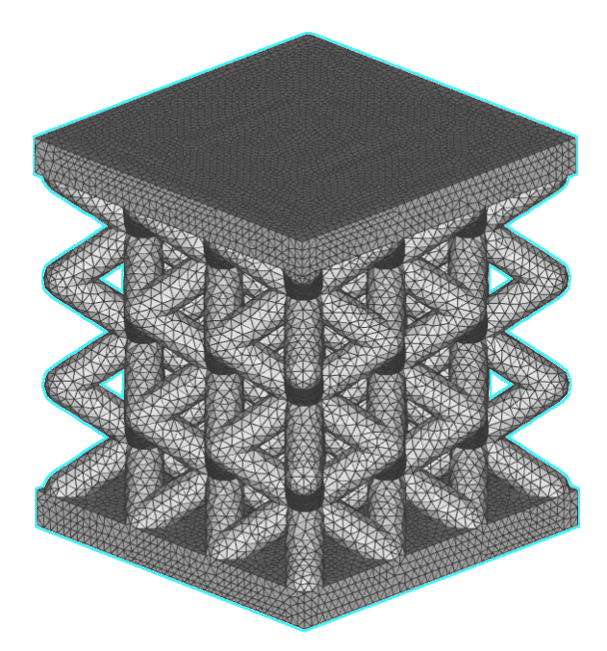
- Best accuracy
- Considers blend lattice-wall radius
- Captures edge effects and stress concentrations
- Meshing challenges for complex lattice structures
- Small mesh element size is needed to capture the detail of the lattice
- Result is dependent on mesh quality
- Takes a long time to compute
- Generates large file size
Setup
The setup for this method is the same as for running static structural analysis on any other non-latticed parts. This includes creating an FE Model containing the FE Solid Component of your lattice structure and defining your load case in the Boundary Conditions. You can then put the completed FE Model and Boundary Conditions into the Static Analysis block and let it run.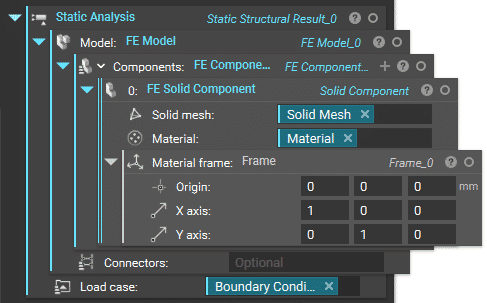
FE Solid Component
You can use either the FE Component block and fill out the Attribute as FE Solid Attribute or the built-in toolkit block FE Solid Component, which lets you skip the step of defining the attribute type.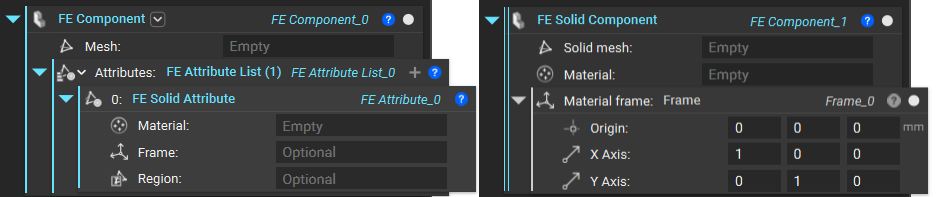
FE Volume Mesh for Lattices
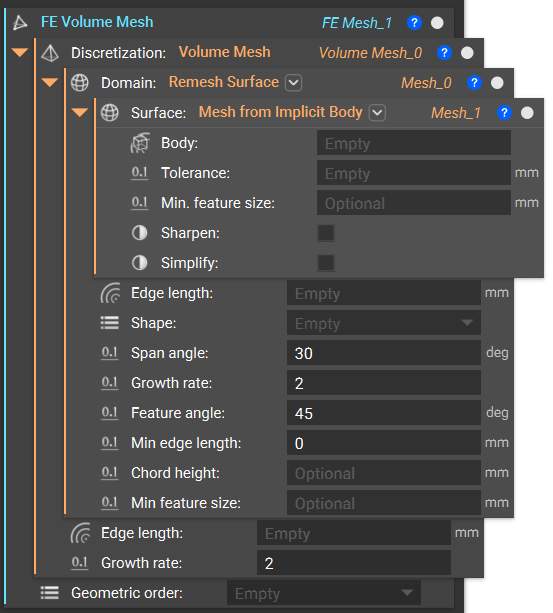
To create the FE Volume Mesh of your lattice structure, which you need as input for the FE Component, start with this recommended workflow. This combination of blocks converts your implicit body into a surface mesh, remeshes it to be suitable for FEA, then generates and discretizes a volumetric mesh with assigned nodes. The recommended tolerance for the Mesh from Implicit Body block is 30% of the smallest feature in your part.