

Picking up where we left off
In Lesson 1, you sat with the design engineer who was asked for 12 OML configurations by tomorrow — and you learned why nTop’s implicit, field-based representation means that a request doesn’t end in broken geometry. This lesson explores the following question: If geometry can survive unlimited changes, what does that unlock for how a team builds a product — from the first sketch of a concept to a part coming off a manufacturing line? The answer? It changes where and how design, analysis, and manufacturing interact. This lesson explores that shift and why nTop can play a role across multiple stages of product development, not just at a single step.One engine, many entry points
Because an nTop model doesn’t break under large parameter changes, the same underlying workflow can be pushed on from multiple directions at once: a systems engineer changing a performance requirement, a stress engineer tightening a load case, a manufacturing engineer adding a forming constraint. None of those changes requires rebuilding the geometry from scratch. That’s the real answer to “where does nTop fit” — not at one stage, but as connective tissue across every stage . The four case studies later in this lesson each show that same engine showing up at a different point in the timeline:Waterfall vs agile – why this distinction matters
Most hardware programs still run on a waterfall model: requirements → concept → detailed design → analysis → manufacturing → test, each phase gated behind sign-off on the last. It works, but it’s brittle; a problem found late is expensive to fix, and in a B-rep world, a late design change is exactly what breaks the model. Because nTop’s geometry doesn’t break, teams can run something closer to an agile/concurrent model—where design and analysis loop continuously, and where conceptual and detailed design can happen at the same time instead of waiting on each other.
nTop doesn’t force a team into one model or the other — it shows up successfully in both. It removes the technical reason teams were historically forced into waterfall in the first place: fragile geometry. That’s why you’ll see nTop equally at home inside a defense prime’s stage-gated program and a startup’s weekly sprint.
In-product analysis & external solver integration
The second reason nTop shows up at so many points in a pipeline is that it doesn’t force a choice between “design tool” and “simulation tool,” and it plays well with tools already in your stack. Inside of nTop, natively:- Linear static, thermal, modal, and global buckling structural analysis
- Topology optimization and field optimization
- Flow Analysis — a GPU-accelerated, meshless CFD solver for rapid internal-flow exploration
Case study 1 — Conceptual / Preliminary Vehicle Design: Specter Aerospace
Industry: Aerospace & Defense (hypersonics) Application: Parametric hypersonic vehicle model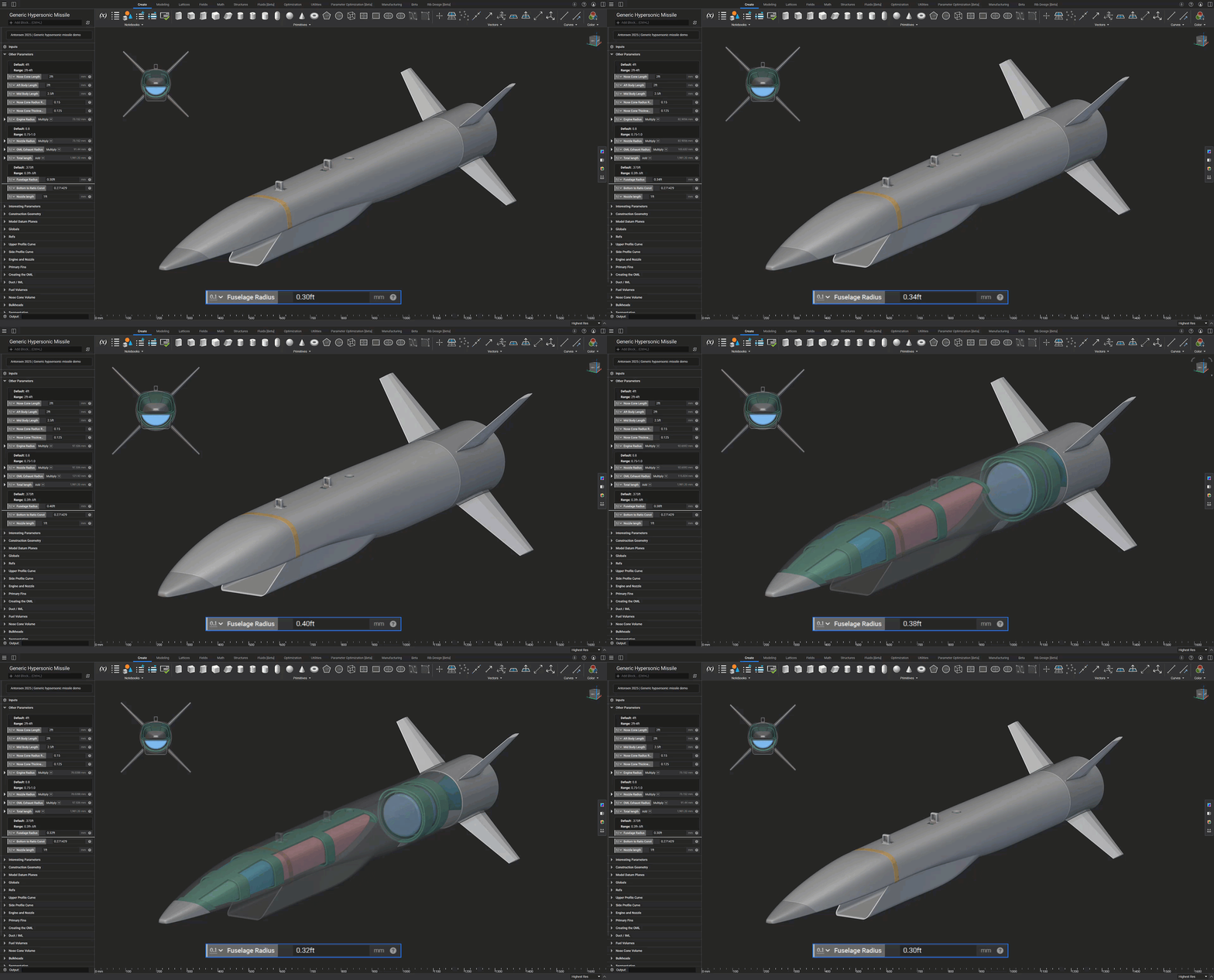
Case study 2 — Encoding Manufacturing Constraints: Machina
Industry: Advanced manufacturing (AI-driven robotic metal forming) Application: Dieless sheet-metal forming (“Roboforming”) for aerospace and defense structures Machina builds software-defined factories where pairs of industrial robots incrementally shape sheet metal — titanium, high-strength aluminum, and more — into finished parts with no dies, molds, or dedicated tooling. That only works if the digital design already respects the physics of the forming process: minimum bend radii, achievable draw depth, springback, wall-thickness limits. Machina’s own team includes several engineers with an nTop background, and the two companies have publicly demonstrated joint projects, including a Class 3 UAV airframe built with zero hard tooling. Why this matters for waterfall vs. agile: In a stage-gated process, “design for manufacturability” is usually a review — a separate team checks a finished design against process limits, and a failure sends it back to square one. When manufacturing constraints are encoded directly as parameters inside the model, that review becomes continuous: every geometry the model can produce is already inside the manufacturable envelope. That’s what enables reconfigurable, rapidly-iterated defense and aerospace programs, where a design has to change and still be buildable the same day. In-product analysis + external solvers: Because tooling isn’t fixed, the constraint that matters shifts from “can this be die-cast” to “can this be formed within this robot cell’s process window” — a rule nTop can encode directly in the model, then hand off to Machina’s manufacturing execution system.Case study 3 — Detailed Design Optimization: Ocado (Topology Optimization & Static Analysis)
Industry: Robotics/grocery fulfillment automation Application: Lightweighting the chassis of Ocado’s “600 Series” fulfillment robot Ocado’s warehouse robots race across a 3D grid at up to 4 m/s, retrieving crates of groceries. Every gram matters — lighter bots need smaller motors and batteries, put less strain on the grid, and let Ocado build lighter, cheaper grids overall. Ocado’s team used nTop’s topology optimization and static structural analysis to rebuild the bot’s chassis, generating hundreds of lightweight design candidates per sprint. Why this matters for waterfall vs. agile: Ocado’s engineering culture runs on the same sprint-based methodology as its software teams — but that only works for hardware if the design tool can keep pace. Generating and structurally validating hundreds of candidate geometries within a single sprint isn’t possible with feature-tree CAD, where every topology change risks breaking the model. This is what lets a hardware team run genuinely agile sprints instead of the multi-week CAD cycle waterfall development. In-product analysis + external solvers: Topology optimization and static analysis both run natively inside nTop, so the loop of “optimize → check stress and displacement → adjust load cases → re-optimize” never requires leaving the tool. The validated geometry then moves into Onshape for team collaboration and out to HP’s additive manufacturing hardware for production. Headline numbers: The team cut chassis weight by roughly 50–70%, and public reporting on the resulting bot describes it as multiple times lighter than its predecessor.Case study 4 — Detailed Design Optimization: Cobra Puma Golf (Field Optimization)
Industry: Sporting goods Application: LIMIT3D — the first commercially available 3D-printed golf irons Cobra wanted an iron with the look and feel of a pro-level forged blade, but the forgiveness of a game-improvement club for average golfers — a combination that depends on precisely controlling where mass sits inside the clubhead, and how the structure vibrates on impact. That’s a job for field-driven design: instead of modeling a lattice as thousands of individual struts, nTop represents it as a continuously varying field, letting Cobra tune density, cell style, and orientation smoothly across the part. Why this matters for waterfall vs. agile: Cobra didn’t start from a blank sheet — they reused a parametric workflow originally built for a 3D-printed putter and adapted it for an entirely different club. That’s the payoff of building workflows rather than one-off models: each new product starts with institutional knowledge already encoded in a block, rather than restarting the design process from scratch. That’s a very different, faster development rhythm than a waterfall process where every new SKU begins from a fresh CAD file. In-product analysis + external solvers: Field optimization inside nTop lets Cobra balance three requirements normally handled in separate, sequential steps — mass distribution, acoustic/vibration performance, and print manufacturability (build and lattice orientation) — all in the same parametric model, before exporting the finished implicit geometry into their existing CAD environment for production. Headline numbers: Cobra cut development time by roughly a year, redistributed about 33% of the clubhead’s mass to the perimeter for better forgiveness, and eliminated the cost of hard tooling entirely by going straight to additive manufacturing.Bringing it together
Whether a team is locked into a regulated, milestone-driven waterfall program (Specter, operating under defense export controls) or running fast software-style sprints (Ocado, Cobra), the same unbreakable, parametric engine from Lesson 1 removes the technical reason those teams would otherwise be forced to work sequentially around fragile geometry.
What to Take Away
- nTop’s robust, implicit modeling engine supports workflows across conceptual design, detailed engineering, analysis, and manufacturing.
- Because geometry remains stable through significant parameter changes, teams can explore more design variations without rebuilding models repeatedly.
- Design, analysis, and manufacturing constraints can be integrated earlier and evaluated concurrently, enabling more iterative and agile development.
- nTop provides built-in analysis tools to support rapid design exploration and integrates with external solvers for detailed analysis and final validation.