

- Accurate pressure drop prediction across complex geometries to minimize energy losses and optimize system designs.
- Effective simulation of laminar, turbulent, and transitional flow regimes for comprehensive and accurate flow behavior analysis
- Detection and visualization of recirculation zones to improve flow efficiency and system reliability
- Maximum velocity calculation to detect critical high-speed zones and prevent erosion or mechanical failure.
- Flow path analysis to detect blockages and inefficiencies for enhanced flow distribution and reduced pressure losses.
- Identification of high-fluid velocity zones and flow separation points via instantaneous and time-averaged velocity and pressure distributions.
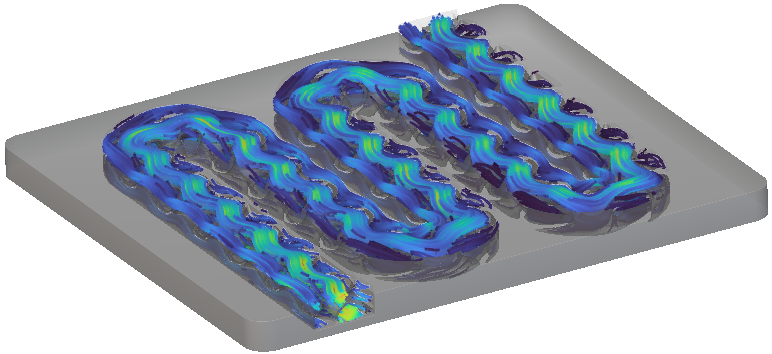
Heat Exchangers
Heat Exchangers
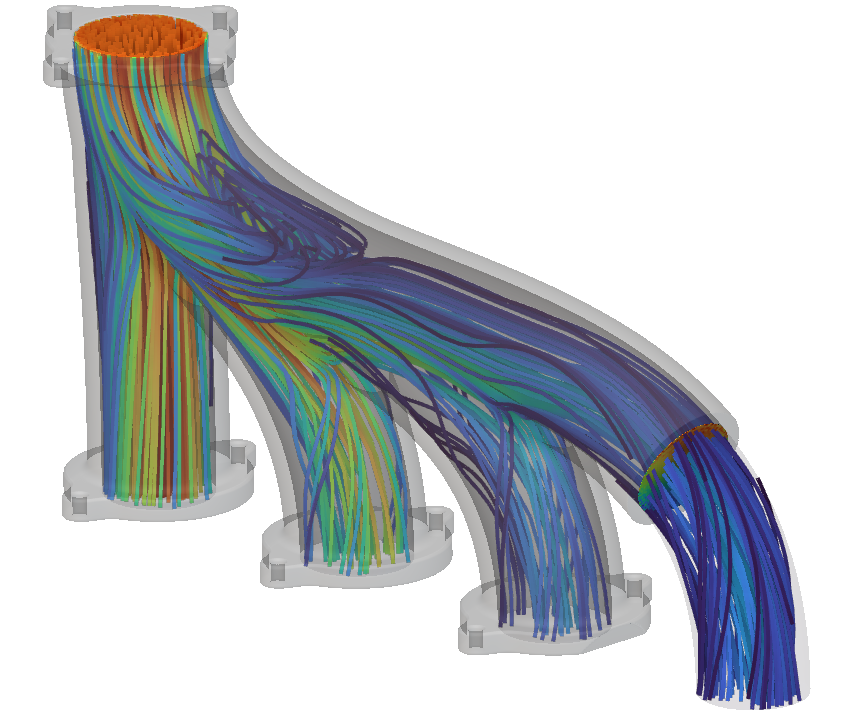
Manifolds
Manifolds
Turbines
Turbines
Pressure Drop Calculation: Reduces pressure losses in cooling or lubrication systems to maintain turbine efficiency.Flow Regime Transition: Prevents unwanted turbulence in cooling passages that could lead to erosion or inefficiencies.Recirculation Zone & Vortex Detection: Prevents localized turbulence that could lead to energy losses or component wear and minimizes vortex-induced vibrations that could lead to fatigue failure.Maximum Velocity Prediction: Protects components from high-speed fluid erosion, improving durability.Flow Path Analysis: Optimizes cooling paths to prevent overheating and maintain efficiency.Flow Homogeneity: Improves cooling efficiency by ensuring even fluid distribution across turbine blades.Velocity & Pressure Fields: Reduces high-pressure zones that could cause mechanical stress and inefficiencies.Transient Simulation: Evaluates unsteady aerodynamics to improve efficiency and longevity.
Chemical Reactors
Chemical Reactors
- Pressure Drop Calculation: Maintains proper reactant flow, preventing flow restrictions that could impact reaction rates.
- Flow Regime Transition: Maintains the correct flow regime for efficient mixing and reaction kinetics.
- Recirculation Zone & Vortex Detection: Improves reactant flow by reducing stagnant regions that lower reaction efficiency.
- Maximum Velocity Prediction: Prevents excessive shear forces that could damage delicate catalysts or particles.
- Flow Path Analysis: Enhances reactant distribution for more effective chemical processing.
- Flow Homogeneity: Ensures proper reactant mixing for uniform reaction rates and efficiency.
- Velocity & Pressure Fields: Maintains consistent reactant flow to prevent reaction inefficiencies.
- Transient Simulation: Captures dynamic flow interactions for improved reaction efficiency and process control.
Filters
Filters
- Pressure Drop Calculation: Ensures optimal pressure conditions to maintain effective filtration without excessive clogging or back pressure.
- Flow Regime Transition: Optimizes flow behavior to prevent premature clogging and maintain filtration efficiency.
- Recirculation Zone & Vortex Detection: Reduces trapped contaminants and turbulence that could clog or cause inconsistent flow through filters and ultimately reduce flow rates.
- Maximum Velocity Prediction: Avoids excessive stress on filter media, ensuring longer operational life.
- Flow Path Analysis: Identifies flow restrictions that could cause premature clogging or uneven filtration.
- Flow Homogeneity: Prevents uneven loading on filter media, extending lifespan and improving performance.
- Velocity & Pressure Fields: Prevents pressure spikes that could damage filter materials or lead to bypassing.
- Transient Simulation: Models real-time clogging behavior to optimize cleaning and replacement schedules.